
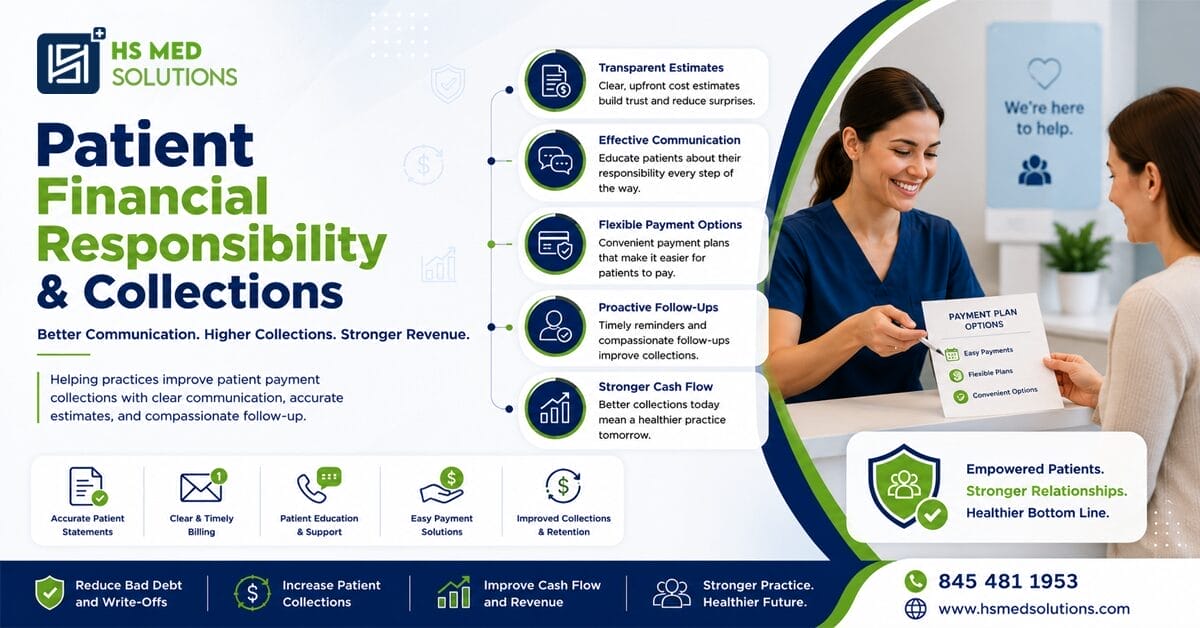
Running a medical practice is hard enough on its own. Add a growing stack of uncollected patient balances, and cash flow becomes a serious problem. The good news? With the right patient collections strategy, most practices can recover significantly more revenue without damaging patient relationships.
This guide breaks down what is driving collection challenges today, and exactly what your team can do to fix them.
Table of contents
- Why Patient Collections Have Become Harder Than Ever
- The Real Cost of Weak Patient Collections
- Verify Insurance Before Every Single Visit
- Collect More at the Time of Service
- Provide Clear, Accurate Cost Estimates
- Offer Flexible Patient Payment Plans
- Send Clear, Patient-Friendly Billing Statements
- Use Digital Billing and Online Payment Options
- Follow Up Systematically on Outstanding Balances
- Train Staff on Patient Financial Communication
- Compliance Considerations in Patient Collections
- When to Involve a Third-Party Collection Agency
- Measuring Your Patient Collections Performance
- FAQ: Patient Collections
- What is the best time to collect from patients?
- How can I improve patient collections without damaging relationships?
- Should my practice offer payment plans?
- What happens when patients refuse to pay?
- How does insurance verification help with patient collections?
- Is it legal to require payment before services?
- What digital tools help with patient collections?
- Build a Collections Process That Works Every Time
Why Patient Collections Have Become Harder Than Ever
A decade ago, most patients had low or zero deductibles. Insurance covered the bulk of the bill. Your front desk collected a small copay, and that was that.
That world no longer exists.
Today, the average single-coverage deductible has hit $1,886, up 17% in just five years. Out-of-pocket costs continue to rise by roughly 3.2% per year. Patients are responsible for a bigger slice of every bill, and many are not financially prepared to pay it.
According to recent data, approximately 36% of US households carry some form of medical debt. About 21% have at least one overdue medical bill. Many patients pay in installments, use credit cards, or stop responding to billing statements altogether.
For healthcare providers, this shift in patient financial responsibility creates a real problem. When patients cannot or will not pay, your practice absorbs the loss. Uncollected balances pile up in accounts receivable. Cash flow tightens. Staff time gets wasted chasing payments that may never come.
The solution is not to pressure patients or send every unpaid account to a third-party collection agency. The solution is to build a smarter, earlier, and more patient-friendly collections process from the start.
The Real Cost of Weak Patient Collections
Most practices focus heavily on insurance claims. Denials, appeals, resubmissions, and payer follow-up get attention. Patient balances often get treated as secondary.
That is a costly mistake.
The cost shows up in several ways:
- Cash flow disruption: Delayed payments leave gaps between expenses and revenue.
- Higher administrative burden: Chasing old balances takes more time and more staff hours.
- Write-offs and bad debt: Accounts that age past 120 days rarely get paid in full.
- Lost revenue: Many practices never collect 20% to 30% of what patients owe.
The longer a balance sits unpaid, the harder it becomes to recover. Studies consistently show that collection rates drop sharply once an account reaches 60 days past due. After 90 days, recovery rates fall below 50% for many practices.
Front-loading your collection efforts, meaning collecting as much as possible before and at the time of service, is the most effective strategy available.
Verify Insurance Before Every Single Visit
Every uncollectable patient balance starts somewhere. Often it starts with a surprise, either for the patient or for your practice.
Patients do not always know what their insurance covers. They do not track their deductible status. They do not understand coinsurance or out-of-network billing. When they get a larger bill than expected, some pay it. Many do not.
Insurance verification done before the appointment changes this dynamic completely.
What Solid Insurance Verification Looks Like
A proper pre-visit verification process should confirm:
- Active coverage and plan status
- Deductible amounts and how much has been met year-to-date
- Copay and coinsurance requirements
- Prior authorization needs
- Out-of-network status for your practice
- Referral requirements, if applicable
When you have this information before the visit, your front desk team can give patients a realistic cost estimate. Patients can plan. Surprises go away. And your team can collect with confidence because the numbers are accurate.
Skipping or rushing insurance verification is one of the most expensive habits a medical practice can have. It leads to denied claims, delayed payments, and patient confusion that stalls collections for weeks.
Collect More at the Time of Service
Time-of-service collections are the single highest-leverage change most practices can make.
Collecting before or immediately after the appointment is far more effective than sending a statement two weeks later. The patient is already there. The visit is top of mind. And you avoid the friction of a mailed bill that gets ignored, lost, or disputed.
What to Collect at the Visit
At a minimum, your front desk should collect:
- All known copays at check-in
- Any outstanding balances from previous visits
- Estimated patient responsibility based on deductible and coinsurance
- Self-pay deposits for patients without active insurance
For patients with known deductibles that have not been met, collect an estimate upfront. Collect the full estimated responsibility if possible. If not, set up a payment plan before the patient leaves.
Training Your Front Desk Team
Many front desk staff feel uncomfortable asking patients for money. This is understandable. However, it is a trained behavior, and it can be changed.
Develop a simple, clear script for your team. Practice it. Role-play common scenarios. Make the conversation feel like a natural part of check-in rather than an awkward add-on.
A simple approach that works well:
“Mrs. Johnson, your insurance shows a $35 copay today, plus you have $200 remaining on your deductible. We can take care of that now, or we can set up a payment plan that works for your budget.”
This is not aggressive. It is clear, respectful, and professional. Most patients respond well to direct, honest conversations about cost, especially when they feel like the process is fair.
Provide Clear, Accurate Cost Estimates
Patients are much more likely to pay when they understand exactly what they owe and why.
Medical billing is notoriously confusing. Most patients cannot read an Explanation of Benefits (EOB). Many do not understand the difference between a deductible and a copay. When they receive a statement with multiple line items, obscure billing codes, and an amount that differs from what they expected, confusion quickly turns into avoidance.
Clear, upfront cost estimates reduce that friction.
Before or at the appointment, give the patient a written estimate that shows:
- The expected cost of the visit or procedure
- What their insurance is projected to cover
- The estimated patient responsibility
- Payment options available
Practices that provide cost estimates consistently report better collection rates. Patients who know what they will owe before they leave are more likely to make a payment or set up a plan before walking out the door.
Offer Flexible Patient Payment Plans
Some patients genuinely want to pay but cannot afford a large lump sum. Meeting them with flexible options keeps accounts out of collections and maintains the patient relationship.
How to Offer Effective Payment Plans
Effective payment plans are simple and structured. They should include:
- A clear monthly payment amount
- A defined payoff timeline
- Automatic payment options via card on file or ACH
- A written agreement that the patient signs
For balances under $500, a two to three-month plan is usually sufficient. For larger balances, plans up to twelve months are common. Some practices use zero-interest financing options for high balances, where the practice receives payment immediately from a third party, and the patient pays the third party over time.
The key is to never let a patient leave without a clear resolution. Either they pay in full, or they commit to a plan. Leaving it open-ended almost always results in a balance that never gets collected.
Card on File Programs
One of the most effective tools in patient collections today is the card-on-file program. The patient provides a card at registration. After insurance processes the claim, the remaining balance is charged automatically, up to an agreed amount.
This removes the billing statement step entirely. No mailed invoice, no patient phone call, no waiting. The balance gets collected faster, and your staff spends far less time on follow-up.
Card-on-file programs require clear patient consent and a written authorization form. When properly implemented, they significantly reduce days in accounts receivable for patient balances.
Send Clear, Patient-Friendly Billing Statements
When a balance does go to a statement, the statement itself matters. Poorly designed statements with confusing language and missing payment instructions are a hidden cause of uncollected balances.
A strong patient billing statement should:
- Show the service date and description in plain language
- Display what insurance paid and what the patient owes
- Include a clear due date
- List every payment option with instructions
- Be visually easy to read with no dense blocks of text
- Include a phone number for billing questions
Avoid jargon. Avoid abbreviations that patients will not recognize. Write the statement as if the reader has no prior knowledge of how medical billing works. That assumption is more accurate than most practices realize.
Use Digital Billing and Online Payment Options
Patients increasingly expect to manage everything on their phones. Healthcare billing is no exception.
Recent surveys show that more than 60% of patients prefer to pay their medical bills online. Yet many practices still rely heavily on paper statements and phone payments. The gap between patient preference and practice capability is a direct cause of uncollected balances.
Digital billing tools include:
- Online payment portals: Allow patients to pay 24/7 from any device.
- Text-to-pay: Sends a secure payment link directly to the patient’s phone.
- Email statements: Faster delivery, easier to act on immediately.
- Patient portal messaging: Secure communication about billing questions without the phone tag.
- Automated payment reminders: Pre-scheduled reminders at set intervals reduce the need for manual follow-up.
Offering multiple digital payment options does not just improve convenience. It actively reduces the friction that causes patients to delay or ignore billing statements. The easier you make it to pay, the faster and more often patients actually pay.
Follow Up Systematically on Outstanding Balances
Even with strong upfront processes, some balances will require follow-up. The key is to make that follow-up systematic, not sporadic.
A structured patient collection follow-up sequence looks like this:
- Day 1-7: Statement sent immediately after insurance processes the claim
- Day 14: First automated reminder (email or text)
- Day 30: Second statement with a clear due date
- Day 45: Phone call from a billing team member
- Day 60: Final notice with a specific deadline before further action
- Day 90+: Account reviewed for payment plan, hardship options, or escalation
Each touchpoint should be respectful. Never use threatening language. Focus on resolution, not pressure. Patients who feel respected are far more likely to engage and work out a solution.
Train Staff on Patient Financial Communication
Your collection results are only as strong as the conversations your team has with patients. Training is not optional here. It is foundational.
Front desk and billing staff should be trained on:
- How to explain costs clearly and confidently
- How to present payment options without apologizing for them
- How to respond to common objections without escalating tension
- How to document financial conversations accurately
- How to identify patients who qualify for financial assistance
- How to escalate accounts appropriately when a patient is non-responsive
Regular training refreshers help keep these skills sharp. Role-playing scenarios are particularly effective. When staff feel confident in these conversations, patients respond better, and collection rates improve.
Compliance Considerations in Patient Collections
Patient collections must follow legal and regulatory requirements. Violating them can expose your practice to serious liability.
Key Compliance Areas
HIPAA: Patient financial information is protected health information. Handle it accordingly. Billing statements, phone calls, and digital communications all have HIPAA implications.
No Surprises Act: For out-of-network services and uninsured patients, you are required to provide a Good Faith Estimate before non-emergency services. Failure to comply carries penalties.
FDCPA (Fair Debt Collection Practices Act): If you use a third-party collection agency, they must comply with FDCPA rules. Your practice can also be held liable for engaging agencies that use prohibited collection tactics.
State laws: Many states have additional protections around medical debt, balance billing, and collection practices. New laws in several states now restrict medical debt reporting to credit bureaus. Stay current on your state’s rules.
Financial assistance policies: If your practice is a nonprofit or participates in certain programs, you may have obligations to screen patients for financial assistance eligibility and communicate those options clearly.
Working with a knowledgeable medical billing partner helps ensure your collections process stays fully compliant as laws continue to evolve.
When to Involve a Third-Party Collection Agency
Most practices should exhaust internal follow-up options before sending an account to an outside collection agency. Third-party collections often damage the patient relationship permanently, and recovery rates vary widely.
Consider escalating to a collection agency only when:
- The account is 120 days or more past due
- Multiple contact attempts have received no response
- The balance is large enough to justify the agency’s fee
- Internal resources for continued follow-up are exhausted
When selecting a collection agency, verify that they are FDCPA-compliant and have healthcare-specific experience. Review their methods carefully. An agency that uses aggressive or non-compliant tactics reflects on your practice, not just on them.
For smaller balances or patients with payment history, a financial hardship review or write-off may be a better resolution than third-party collections.
Measuring Your Patient Collections Performance
If you are not tracking your collection metrics, you cannot improve them.
The most important numbers to watch include:
- Collection rate: The percentage of patient responsibility actually collected
- Days in A/R (patient balances): How long do patient balances take to resolve
- Bad debt percentage: Revenue written off as uncollectable
- Time-of-service collection rate: What percentage of balances is collected at the visit
- Statement-to-payment rate: How many statements result in payment without further follow-up
Benchmark your numbers against industry standards. Most high-performing practices collect 85% to 95% of patient responsibility. If your rate is significantly below that, a targeted improvement plan is worth the investment.
Review these metrics monthly. Look for trends. Identify which payers, patient demographics, or service types produce the most collection challenges. Then adjust your strategy accordingly.
FAQ: Patient Collections
What is the best time to collect from patients?
The best time is before or at the time of service. Collecting at check-in, after verifying insurance and providing an estimate, gives you the highest chance of recovery. The further a balance moves past the date of service, the harder it becomes to collect.
How can I improve patient collections without damaging relationships?
Lead with transparency. Give patients clear estimates upfront, explain their financial responsibility kindly, and offer flexible payment options. Most patients are willing to pay when the process is easy, clear, and respectful.
Should my practice offer payment plans?
Yes. Payment plans are one of the most effective tools for recovering large balances. Patients who cannot afford a lump sum will often pay reliably in smaller installments, especially when automatic payment options are available.
What happens when patients refuse to pay?
First, try to understand the reason. Many non-payers either do not understand the bill, are waiting on a secondary insurance, or are experiencing genuine financial hardship. Address the root cause first. If the account remains unresolved after a structured follow-up process, review it for hardship write-off or third-party escalation.
How does insurance verification help with patient collections?
Verification before the visit gives you accurate deductible and coinsurance data, so you can collect the right amount at the right time. It also reduces billing errors and unexpected balances that cause patients to dispute or delay payment.
Is it legal to require payment before services?
For elective and non-emergency services, yes, in most cases. You must provide care in emergencies regardless of payment. Always consult your state’s specific rules and any contractual payer requirements.
What digital tools help with patient collections?
Online payment portals, text-to-pay solutions, patient portal messaging, and automated billing reminders all significantly improve collection rates. Card-on-file programs are especially effective for recovering balances after insurance pays.
Build a Collections Process That Works Every Time
Patient collections do not have to be a constant struggle. The practices that recover the most revenue do it by building a clear, consistent process and sticking to it across every visit.
The key steps are simple, even if executing them well takes effort:
- Verify insurance before every visit
- Estimate and communicate costs upfront
- Collect at the time of service
- Offer flexible payment options
- Send clear statements and follow up systematically
- Train your staff to handle financial conversations well
- Stay compliant with evolving regulations
Every step in this process reduces the gap between what patients owe and what your practice actually collects. Over time, those improvements add up to significant revenue recovery and a healthier practice overall.
HS MED Solutions helps medical practices across the USA build stronger patient collections systems as part of a complete revenue cycle management solution. Whether you need help with billing workflows, insurance verification, payment plans, or full RCM outsourcing, our team has the experience to drive better results.
Contact HS MED Solutions today at 845-481-1953 or email info@hsmedsolutions.com to find out how we can improve your patient collections and protect your cash flow.