

Table of Contents
Your front desk is already stretched thin. Your biller just gave notice. And somewhere in your accounts receivable, tens of thousands of dollars are sitting uncollected, aging past 90 days and quietly writing themselves off.
This is the reality for thousands of medical practices across the United States right now.
Outsourcing medical billing has become one of the most impactful operational decisions a healthcare provider can make. Done right, it can recover lost revenue, reduce administrative chaos, and free up your clinical staff to focus on what matters: patient care.
But done wrong, with the wrong partner, the wrong contract, or the wrong expectations, it can make things worse.
This guide covers everything you need to know before making that decision. Whether you run a solo practice, a multi-provider group, or a specialty clinic, the information here is built specifically for US-based healthcare providers navigating billing in 2026.
What Does It Mean to Outsource Medical Billing?
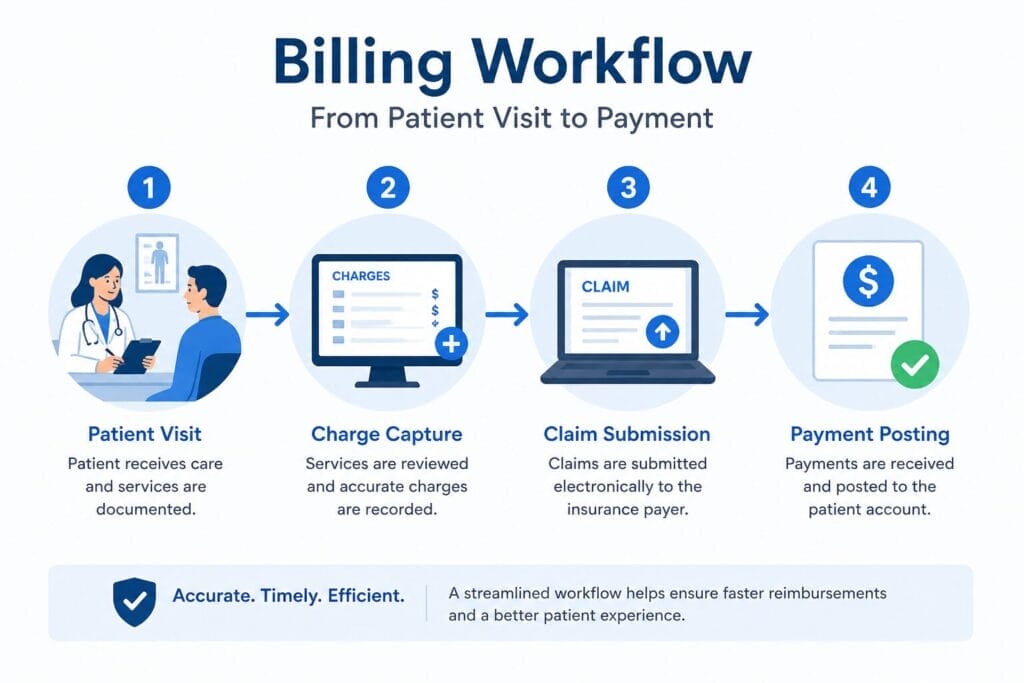
At its simplest, outsourcing medical billing means hiring a third-party company to handle the financial back-end of your practice. It covers everything that happens after a patient visit is documented and the encounter is closed.
That includes:
- Charge entry and coding review
- Claim creation and submission
- Insurance verification and eligibility checks
- Payment posting
- Denial management and appeals
- Accounts receivable follow-up
- Patient billing and statement processing
An outsourced billing company takes on these functions as a dedicated extension of your team. They are not a software tool. They are a specialized workforce of certified coders, billing specialists, and AR managers focused entirely on getting your practice paid accurately and on time.
The Full Scope of What Gets Outsourced
The depth of what an outsourced billing company handles varies depending on the arrangement. Some practices outsource their entire revenue cycle from front-end eligibility checks through back-end AR management. Others outsource only the pieces where their internal team struggles, most commonly denial management and follow-up.
A comprehensive outsourced medical billing service typically covers:
Front-End Functions
- Insurance eligibility verification before appointments
- Prior authorization coordination
- Patient demographics and data entry
Mid-Cycle Functions
- Medical coding (ICD-10, CPT, HCPCS)
- Charge entry and scrubbing
- Claim submission to payers
Back-End Functions
- Payment posting and reconciliation
- Denial tracking, appeals, and resubmission
- Accounts receivable management
- Patient statement processing and collections
What Stays In-House (and What Does Not Have To)
Even with full outsourcing, some functions remain internal by nature, including scheduling, clinical documentation, and direct patient communication. But many practices are surprised to learn that even patient billing questions can be routed through their outsourced partner’s call center, leaving the front desk free to focus on care coordination.
Is Outsourcing Medical Billing Right for Your Practice?
Not every practice needs to outsource. But many that do not outsource are leaving money on the table and burning out their staff in the process.
Here are the clearest warning signs that your current billing process is costing you more than you realize.
Signs Your Current Billing Process Is Costing You Money
Your denial rate is above 5%. Industry benchmarks put a healthy denial rate below 5%. If yours is higher, something is breaking down, whether that is coding accuracy, front-end eligibility checking, or claim scrubbing before submission.
Your days in AR exceed 35 to 40 days. The longer a claim sits unpaid, the less likely it is to be collected in full. Most high-performing billing operations maintain days in AR between 25 and 35 days. If yours is climbing past 40, the bleeding has already started.
Your billing staff is constantly behind. Backlogs in billing do not just slow down cash flow. They create compounding problems. Denied claims go unworked, timely filing limits expire, and eventually revenue disappears entirely.
You have experienced turnover in your billing department. Replacing a qualified medical biller takes an average of 30 to 90 days. During that window, claims slip. If your billing team has turned over even once in the past two years, you have likely absorbed revenue loss you have never fully measured.
Your EHR is generating reports you do not understand or review. If no one in your practice is actively monitoring collection rates, clean claim rates, and payer-specific denial patterns, you are managing revenue blind.
The 5 Questions Every Practice Should Ask First
Before deciding whether to outsource, ask yourself:
- What is our net collection rate, and is it above 95%?
- What percentage of our claims get denied on first submission?
- How quickly are denials being worked, within 14 days or longer?
- If our billing manager left tomorrow, what would break first?
- How much time does our clinical staff spend on billing-related questions?
Honest answers to these five questions will tell you more than any sales pitch. If three or more reveal problems, the case for outsourcing is strong.
The Real Cost of Outsourcing Medical Billing in 2026
This is the section most articles skip over, or answer so vaguely it becomes useless. Here are the actual numbers.
Typical Pricing Models
Outsourced medical billing companies generally charge in one of three ways:
Percentage of collections (most common). The billing company earns a percentage of what they collect on your behalf. Rates typically range from 4% to 9%, depending on specialty, practice size, claim volume, and the complexity of services.
- Solo primary care practice: expect 6 to 9%
- Multi-provider specialty group: expect 4 to 7%
- High-volume hospital-based practice: can negotiate as low as 3 to 5%
This model aligns incentives well. The billing company only earns when you get paid. That said, watch for contracts that calculate the percentage on billed charges rather than collected revenue, since that structure can inflate their fee significantly.
Flat fee per claim. Some companies charge a fixed amount per claim submitted, typically between $3 and $8. This works well for practices with high claim volumes and relatively simple billing. It works poorly when claims require significant follow-up or resubmission, since the company earns the same regardless of effort.
Hybrid model. A base monthly fee plus a smaller percentage of collections. This is increasingly common with mid-sized practices. It gives the billing company revenue predictability and keeps their percentage low for the practice.
What You Actually Save: In-House Costs vs. Outsourced Costs
| Cost Category | In-House Billing | Outsourced Billing |
|---|---|---|
| Billing staff salary (1 to 2 FTEs) | $45,000 to $85,000/year | Included in service fee |
| Payroll taxes and benefits (25 to 30%) | $11,000 to $25,000/year | $0 |
| Medical billing software | $3,000 to $12,000/year | Typically included |
| Continuing education and certification | $1,500 to $3,000/year | $0 |
| Overtime and temp coverage | Variable | $0 |
| Revenue lost to errors and denials | Often 5 to 15% of potential revenue | Reduced significantly |
| Total estimated annual cost | $60,000 to $125,000+ | 4 to 9% of collections |
For a practice collecting $1 million annually, outsourcing at 7% costs $70,000. That is likely less than the fully-loaded cost of one competent in-house biller, without the turnover risk.
Hidden Costs to Watch For
Not all outsourced billing contracts are transparent. Before signing, ask about:
- Setup and onboarding fees (some companies charge $500 to $2,500 upfront)
- Fees for rejected claims that require resubmission
- Charges for credentialing or enrollment services (often billed separately)
- Contract exit terms and data export fees
- Whether patient statement mailing costs are included
In-House vs. Outsourced Medical Billing
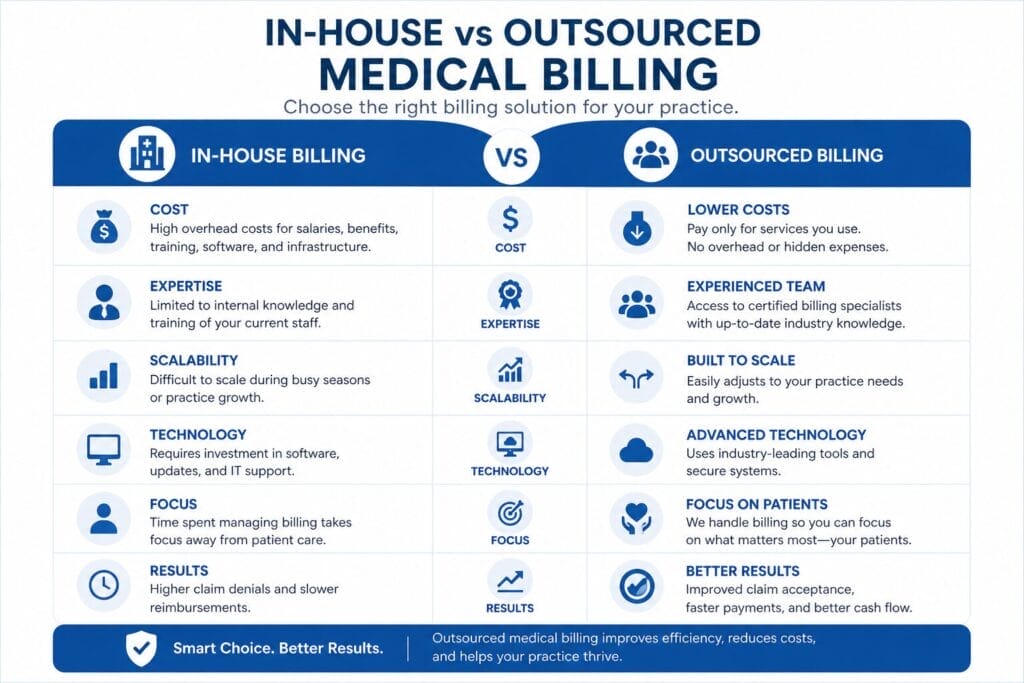
| Factor | In-House Billing | Outsourced Billing |
|---|---|---|
| Staffing risk | High (turnover, training, absences) | Low (managed by vendor) |
| HIPAA compliance burden | Falls on the practice | Shared with billing partner |
| Coding expertise | Depends on individual staff | Access to certified coders |
| Scalability | Requires hiring | Scales with practice volume |
| Technology costs | Practice pays for software | Usually included |
| Denial management | Often reactive and delayed | Systematic and proactive |
| Reporting and visibility | Varies widely | Standardized and frequent |
| Startup cost to change | Low | Moderate (onboarding period) |
| Control and oversight | High | Requires clear contract terms |
When In-House Billing Makes Sense
In-house billing works best when:
- Your practice is very small (under 500 claims per month) and your billing is simple
- You have a long-tenured, highly experienced biller who understands your specialty
- Your payer mix is straightforward, mostly one or two major commercial insurers
- You have invested in strong billing software and your team uses it fully
Even in these situations, a periodic external audit from a billing consultant can uncover gaps that have gone unnoticed for years.
When Outsourcing Is the Smarter Move
Outsourcing makes sense when:
- You are running a multi-specialty or complex-coding practice
- You have experienced billing staff turnover in the last 24 months
- Your denial rate is consistently above 5%
- You are expanding to new locations or adding providers
- Your clinical team is spending time on billing calls instead of patient care
- You want to scale without scaling your administrative headcount
Top Benefits of Outsourcing Your Medical Billing
Faster Reimbursements and Higher Clean Claim Rates
A well-run outsourced billing operation submits claims faster and with fewer errors than most in-house teams. The difference shows up in two ways: a higher first-pass acceptance rate (typically 95%+ vs. the industry average of around 75 to 85% for in-house teams) and shorter days in AR. Faster clean claims mean faster cash. It is that direct.
Reduced Staffing and Overhead Costs
Medical billing staff are not cheap. When you account for salary, benefits, PTO, training, and the productivity hit of turnover, the true cost of in-house billing often surprises practice managers. Outsourcing converts that unpredictable expense into a predictable, performance-linked fee.
Built-In HIPAA Compliance and Security
Reputable billing companies operate under Business Associate Agreements (BAAs) and maintain rigorous HIPAA compliance programs. For practices managing sensitive patient health information, this shared compliance infrastructure reduces liability and keeps your team from needing to stay current with every security regulation update.
Access to Certified Coders and RCM Specialists
Coding errors are one of the most common reasons for claim denials. A dedicated billing company employs CPC-certified coders who specialize in specific specialties, which means fewer unbundling errors, fewer upcoding flags, and better payer relationships over time. This level of specialized coding expertise is very hard to hire and retain in-house for most practices.
Scalability as Your Practice Grows
Adding a provider or opening a new location creates an immediate billing volume spike. In-house, that means hiring. With an outsourced partner, it means a conversation. Good billing companies scale with you without the 60-day lag of a job search.
More Time for Patient Care
This benefit sounds soft but is actually quite measurable. When clinical staff spend less time on insurance calls, billing questions, and denial paperwork, they can see more patients or simply do their jobs better. In a profession already pressed by administrative burden, that is worth more than any dollar amount on a billing invoice.
What Good Outsourced Billing Looks Like in 2026
The medical billing industry has changed significantly in the last few years. A billing company that was considered strong in 2020 may already be falling behind. Here is what you should expect from a modern, high-performing outsourced billing partner.
The Role of AI and Automation in Modern Billing
AI-assisted billing tools are now widely used for claim scrubbing, eligibility checks, and denial prediction. The best billing companies use these tools to flag potential issues before a claim is submitted, not after it is denied. Ask any prospective partner what automation they use and how it improves your first-pass rate.
That said, automation without human oversight creates its own problems. Billing companies that rely entirely on automated systems, with no dedicated account managers or claim-level review, tend to perform poorly on complex specialties and edge-case claims. The right answer is smart automation plus experienced human review.
EHR Integration and Technology Expectations
Your billing company should integrate cleanly with your existing EHR. Whether you use Epic, Athena, AdvancedMD, Kareo, eClinicalWorks, or another platform, the data flow should be smooth and require minimal manual work from your team. Ask specifically how they handle charge capture, how often data syncs, and what happens when there is a discrepancy.
Real-Time Reporting and Transparency
One of the most common complaints practices have after outsourcing is the loss of visibility. A strong billing partner provides:
- A dedicated reporting dashboard accessible to the practice
- Monthly performance reports covering key metrics
- Payer-specific denial trend analysis
- AR aging reports broken down by payer and provider
- Direct access to a dedicated account manager, not just a support ticket queue
If a billing company cannot show you exactly how your money is moving, that is a red flag, not a minor inconvenience.
Specialty-Specific Billing Challenges

Generic billing companies handle volume. Specialized billing companies handle complexity. The difference matters enormously depending on what your practice does.
Primary Care
Primary care billing looks simple from the outside, mostly E/M codes, preventive visits, and chronic care management. In practice, it involves navigating multiple payer contracts, Medicare wellness visit distinctions, and an ever-growing list of value-based care reporting requirements. Practices that miss quality measure documentation lose bonuses they did not even know they qualified for.
Mental Health and Behavioral Health
Mental health billing is one of the highest-complexity niches in the industry. Parity laws, session limits, prior authorization requirements, and the distinct coding rules for psychological testing and psychiatric services create an environment where errors are common and denials are aggressive. A billing company without specific behavioral health experience will cost you more than they save.
Cardiology and Specialty Practices
High-acuity specialties involve frequent high-dollar claims, complex procedure coding, modifier application, and device billing, all of which require coders with specific training. A denial on a cardiac catheterization can mean thousands of dollars lost per encounter. Specialty-specific expertise is not a luxury here; it is a financial necessity.
Multi-Provider Groups
Multi-provider practices add layers of complexity around individual provider credentialing, rendering provider distinctions on claims, and managing different payer contracts across physicians. Without billing infrastructure that tracks all of this systematically, you will see denials and underpayments multiply with each additional provider you add.
Learn more at hsmedsolutions or call 845-481-1953.
How to Choose the Right Medical Billing Partner
The market is full of medical billing companies making similar promises. Most of them sound exactly alike on a sales call. The difference shows up after the contract is signed, and often not in a good way.
Here is how to cut through the noise.
7 Green Flags in a Reliable Billing Company
- They specialize in your practice type or specialty. A company that bills for everything often bills everything at a mediocre level.
- They provide transparent, real-time reporting. You should be able to see your metrics without asking.
- They offer a dedicated account manager. Not a call center. A person you know by name.
- They have a documented onboarding process. Structured transitions reduce errors during the switchover.
- They can show you their average clean claim rate and days in AR for clients like you. If they cannot, ask why.
- They operate under a clear BAA and HIPAA compliance program. Ask to see documentation, not just a verbal confirmation.
- Their contract terms are fair and exit terms are clear. A company confident in their work does not need punishing exit clauses.
5 Red Flags That Should Make You Walk Away
- They cannot explain how they handle denials and appeals specifically. ‘We take care of it’ is not an answer.
- They charge a percentage on billed charges, not collections. This misaligns incentives.
- They promise unusually high collection increases with no supporting data. Aggressive upselling without proof is a warning sign.
- Their reporting is monthly summaries only, with no drill-down access. Minimal reporting is often a sign of minimal performance.
- They use overseas billing teams without clear quality oversight. Offshore billing is not inherently bad, but lack of oversight and certification is.
10 Questions to Ask Before Signing Any Contract
- What is your average first-pass clean claim rate across your current clients?
- What is your average days in AR?
- How do you handle claim denials, and what is your appeal process and turnaround time?
- What EHR systems do you integrate with, and how does data transfer work?
- How do you stay current with coding updates and payer policy changes?
- Who will be our dedicated point of contact, and how do we reach them?
- What does your onboarding process look like, and how long does it take?
- How do you handle HIPAA compliance, and can I see your BAA?
- What happens if we want to end the contract, and what are the exit terms and data access rights?
- Do you have experience billing for practices in our specialty? Can you provide a reference?
How to Transition From In-House to Outsourced Billing
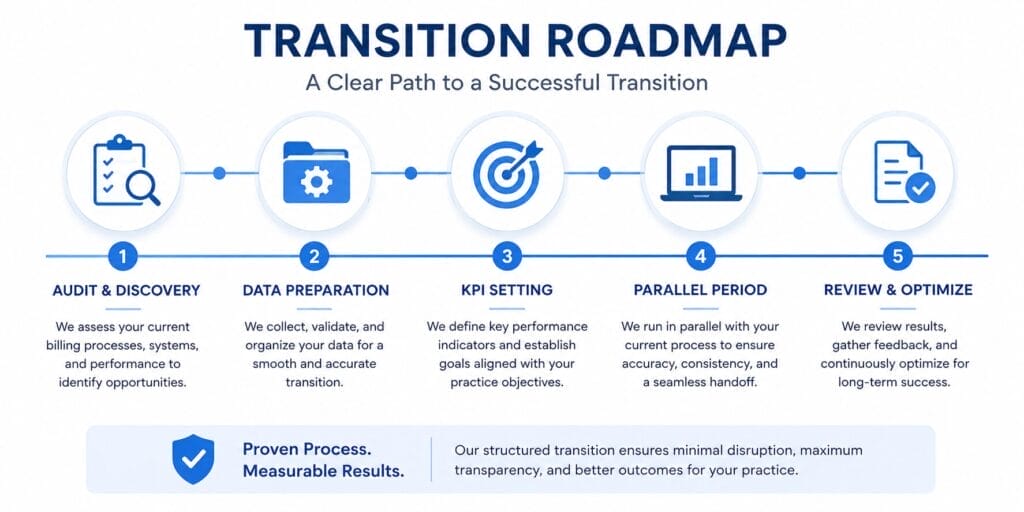
Switching from in-house to outsourced billing is where most practices feel the most anxiety, and where the most errors happen if not managed carefully. A structured transition is not complicated, but it does require attention.
Audit Your Current Revenue Cycle
Before you hand anything off, know where you stand. Run a current AR aging report. Document your denial rate by payer. Note any open appeals. Identify claims that are approaching timely filing limits. This audit accomplishes two things: it tells you what needs immediate attention, and it gives you a baseline to measure your new partner’s performance against.
Prepare Your Data and EHR Access
Your billing partner will need access to your EHR or practice management system. Work with your IT team and the billing company to set up appropriate access levels before go-live. Also prepare a list of your active payer contracts, fee schedules, and any special billing arrangements that are not standard in your system.
Set KPIs Before Day One
Do not wait until something goes wrong to define success. Agree in writing on the performance benchmarks you expect, including days in AR, clean claim rate, denial rate, and net collection rate, before the relationship starts. This creates accountability from the beginning and gives you something objective to evaluate at 30, 60, and 90 days.
Run a Parallel Period (Optional but Smart)
For practices with complex billing or high claim volume, running a parallel period, where both teams handle billing for a short window, allows you to catch any data gaps or submission errors before they affect a full month of revenue. Not every practice needs this, but it is worth considering if your billing is complicated.
Review and Optimize at 90 Days
The first 90 days reveal everything. Schedule a formal performance review at the 90-day mark. Compare current metrics to your baseline. Address any payer-specific issues that surfaced. Establish a regular cadence for ongoing reporting reviews, monthly at minimum, with a quarterly deep-dive.
Key KPIs to Measure Your Billing Company's Performance
You cannot manage what you do not measure. These are the specific numbers that tell you whether your billing partner is performing, or coasting.
| KPI | Benchmark | What It Tells You |
|---|---|---|
| First Pass Acceptance Rate | 95%+ | Are claims submitted correctly the first time? |
| Days in AR (all payers) | Under 35 days | How quickly is money moving from service to payment? |
| Denial Rate | Under 5% | How often are claims rejected and why? |
| Net Collection Rate | 95 to 99% | What percentage of collectible revenue is actually collected? |
| Clean Claim Rate | 95%+ | Are claims submitted without errors requiring correction? |
| AR Over 90 Days | Under 15 to 20% of total AR | How much revenue is at risk of being uncollectable? |
| Appeal Success Rate | 65%+ | Are denied claims being effectively recovered? |
Review these metrics monthly. If any metric is consistently outside benchmark, investigate the specific payer and procedure code patterns behind it. That is where the problem will be.
First Pass Acceptance Rate
The single most predictive metric of billing health. If your billing company is not hitting 95%+ on first-pass claims, your cash cycle is slower than it should be and your team is spending unnecessary time on rework.
Days in AR
This measures how long it takes from service delivery to payment receipt. The clock starts at service and stops when the payment posts. Below 35 days is healthy. Above 45 days signals a systemic issue, either in submission speed, denial volume, or follow-up frequency.
Denial Rate
Track this by payer, not just in total. A 4% overall denial rate can hide a 15% denial rate with one major commercial payer, a payer-specific issue that requires a targeted fix.
Net Collection Rate
This is your ultimate performance number. It measures how much of your allowed revenue (after contractual adjustments) you actually collect. Anything below 95% indicates money is being written off that did not have to be.
Clean Claim Rate
A high clean claim rate means fewer denials, fewer resubmissions, and faster payment cycles. If your billing company is consistently below 95%, ask them to break down the error categories driving the gap.
Appeal Success Rate
A denial is not a final answer. A billing company with strong appeal processes should be recovering 65% or more of denied claims. If theirs is lower, find out why, and what they are doing about it.
2026 Regulatory Changes Affecting Medical Billing

Billing does not happen in a vacuum. Every year brings policy changes that affect how claims are submitted, what gets paid, and what compliance looks like. 2026 brings several developments worth monitoring closely.
Prior Authorization Reform Updates
The CMS prior authorization rules that took effect in 2024 continue to roll out, requiring most payers to implement electronic prior authorization via APIs and to respond to urgent prior auth requests within 72 hours. In 2026, compliance enforcement of these standards is tightening. If your billing company is still managing prior authorization manually or without system integration, you are likely experiencing unnecessary delays.
CMS Reimbursement Rate Adjustments
Each year, the Medicare Physician Fee Schedule adjusts reimbursement rates. For 2026, practices should review specialty-specific conversion factor impacts and evaluate whether their current fee schedules reflect any new payer contract updates. Billing companies should proactively flag fee schedule changes. If yours has not communicated anything about 2026 adjustments, ask.
ICD Coding Updates for 2026
The annual ICD-10-CM update that took effect October 1, 2025 introduced new codes across multiple clinical categories. Your billing team, whether in-house or outsourced, should have already updated their coding reference tools and completed any required training for new code sets. Billing with outdated codes results in rejections that are entirely preventable.
HIPAA Security Rule Amendments
The HIPAA Security Rule was updated in 2025 with new technical safeguard requirements, including enhanced requirements around multi-factor authentication, encryption, and network segmentation for systems handling electronic protected health information (ePHI). If you are outsourcing billing, confirm that your partner has assessed their systems against the updated requirements and updated their BAA accordingly.
Frequently Asked Questions
Most billing companies charge between 4% and 9% of collected revenue, depending on specialty, claim volume, and service scope. Some use flat per-claim fees ranging from $3 to $8. When you factor in the full cost of in-house billing, salary, benefits, software, and turnover, outsourcing is typically cost-competitive and often less expensive.
A full-service outsourced billing arrangement typically includes insurance eligibility verification, medical coding, charge entry, claim submission, payment posting, denial management, accounts receivable follow-up, and patient billing. Some partners also offer credentialing and prior authorization support.
Yes, provided you work with a reputable partner. Any billing company handling your patient data must sign a Business Associate Agreement (BAA) and maintain HIPAA-compliant systems and staff training. Always request documentation of their compliance program before signing any contract.
Most transitions take 2 to 4 weeks. The onboarding process includes EHR access setup, payer contract review, staff introductions, and a test claim batch. Complex practices with multiple specialties or locations may take slightly longer.
A first-pass acceptance rate of 95% or higher is considered strong. Rates below 90% indicate coding or credentialing issues that need to be addressed immediately.
Yes. Many practices outsource specific functions, most commonly denial management, AR follow-up, or patient billing, while keeping other functions in-house. This partial outsourcing model works well when you have a solid internal team but specific gaps in expertise or capacity.
Ask about their clean claim rate, average days in AR, denial management process, EHR integration capabilities, compliance documentation, and references from clients in your specialty. Also review contract exit terms carefully before signing.
Track the key metrics outlined in this guide: net collection rate, denial rate, days in AR, and first-pass acceptance rate. If any of these are consistently outside benchmark and your billing company cannot explain why or show a remediation plan, it is time to reassess the relationship.
When done correctly, it improves patient experience. Faster claim processing means more accurate patient statements, fewer billing errors, and quicker resolution of patient balance questions. Some billing companies also provide patient-facing call center support as part of their service.
Compare your net collection rate, denial rate, and days in AR before and after the transition. Also calculate the true cost difference between your previous in-house model (salary plus benefits plus software plus lost revenue) versus the outsourced fee. Most practices see measurable improvement within 60 to 90 days.
Making the Right Decision for Your Practice
Choosing whether to outsource your medical billing is not a technology decision or an administrative one. It is a business decision with direct implications for your practice’s financial health, staff sustainability, and long-term growth.
The practices that benefit most from outsourcing are not always the ones in the worst financial shape. Often, they are growing practices that recognize the limits of their current setup before those limits create a crisis. Outsourcing works best when you go into it with clear expectations, the right metrics, and a partner who treats your revenue like it matters.
If anything in this guide raised a question you have not been able to answer about your own billing operation, that question is worth pursuing. Hidden revenue leaks and systemic billing problems rarely fix themselves.
HS MED Solutions is a US-based medical billing and revenue cycle management company with over 25 years of experience serving healthcare providers across the country. Their team works with practices of all sizes and specialties, from solo physicians to multi-provider groups, providing billing, coding, credentialing, and full RCM support built around your practice’s specific needs.
If you are ready to explore what outsourced billing could look like for your practice, the conversation starts here