
What Is Revenue Cycle Management? 2026 Guide for Practices

Revenue cycle management is the process that turns the care you deliver into money in your practice’s bank account. Every step from the moment a patient calls for an appointment to the moment the last dollar of that visit is collected belongs to the revenue cycle. When it works, you barely notice it. When it breaks, you feel it as a cash flow problem, and by then the cause is usually 60 to 120 days behind you. That delay is what makes revenue cycle management hard to fix. A denial you receive in March was often caused by a front-desk shortcut in January. A claim that gets written off in June was often coded correctly but never followed up. Practices rarely lose revenue in one dramatic event. They lose it in small, quiet increments across a dozen handoffs, and the loss only becomes visible in the aggregate. This guide explains the full revenue cycle as it actually operates in a U.S. practice in 2026: each stage, who owns it, where it typically breaks, the metrics that tell you the truth about your performance, the regulatory changes now reshaping it, and a practical plan for improving it over the next 90 days. What is revenue cycle management? Revenue cycle management (RCM) is the coordinated set of administrative and clinical processes healthcare organizations use to capture, manage, and collect revenue for patient services. It spans the entire financial life of a patient encounter: scheduling, eligibility verification, documentation, coding, charge capture, claim submission, payment posting, denial management, and patient collections, and its goal is to get every claim paid correctly the first time, as quickly as possible. The phrase revenue cycle is literal. It is a loop, not a line. Information captured at the front desk determines whether the claim pays 45 days later, and what you learn from that payment (or denial) should change what your front desk does next week. Practices that treat RCM as a back-office billing function rather than a full-practice operating system are the ones with 15% denial rates and no idea why. RCM vs. medical billing: what’s the difference? These terms are used interchangeably, and that confusion costs practices money because it leads them to buy a narrower service than they need. Medical billing is the act of preparing and submitting claims and following up on payment. It is a component of the revenue cycle, arguably the most visible one. Revenue cycle management is the whole system, including everything that happens before a claim exists (scheduling, registration, eligibility, prior authorization, documentation, coding) and everything that happens after a payer responds (posting, denial analysis, appeals, underpayment recovery, patient collections, reporting). The practical difference: a billing service submits your claims. An RCM partner asks why 30% of your claims needed rework in the first place, and fixes the front-end process that caused it. If your denial rate is high, more billing effort will not solve it. Only revenue cycle management will. The three phases of the revenue cycle Most revenue cycle problems can be located in one of three phases. Knowing which phase yours lives in tells you where to spend your improvement budget. Phase What it covers Who typically owns it What failure looks like Front-end (pre-service) Scheduling, registration, insurance verification, prior authorization, patient financial counseling Front desk / patient access Eligibility denials, missing authorizations, wrong payer on file, surprise patient balances Mid-cycle (point of service) Clinical documentation, charge capture, medical coding, charge entry Providers and coders Missed charges, undercoding, unsupported medical necessity, documentation that fails audit Back-end (post-service) Claim submission, payment posting, denial management, appeals, AR follow-up, patient collections, reporting Billing team or RCM partner Aging AR, unworked denials, underpayments nobody caught, claims past timely filing Here is the pattern worth internalizing: most back-end problems are front-end problems that have aged. Industry analyses consistently attribute a large majority of denials to issues that were preventable before the claim was ever submitted: eligibility, authorization, registration accuracy, and documentation. That is why practices that invest only in “better billing” plateau, while practices that fix registration and verification see their denial rate drop within a single quarter. Why revenue cycle management matters more in 2026 The mechanics of the revenue cycle have not changed much in a decade. The economics have changed considerably, and in four specific ways. Payers are denying more, and doing it faster Initial denial rates have climbed across the industry, with commonly cited figures now in the 10–12% range for medical claims and materially higher in behavioral health. Payers increasingly use automated review to adjudicate claims at volume, which means a coding pattern that was tolerated for years can start generating denials in a single quarter with no warning and no notice. The practical consequence: denial management can no longer be a monthly cleanup task. It has to be a monitored, categorized, weekly process, because a systemic denial pattern now compounds far faster than a human review cycle can catch it. Patient responsibility keeps growing High-deductible health plans have shifted a substantial and growing share of practice revenue from payers to patients. Patient balances behave nothing like payer balances: they collect at far lower rates the longer they age, they require different workflows, and they are heavily influenced by whether anyone asked for money at the time of service. Most practices still run a revenue cycle designed for a world where insurance paid nearly everything. That is now one of the largest single sources of preventable revenue loss. Prior authorization is being reformed, not eliminated The CMS Interoperability and Prior Authorization final rule (CMS-0057-F) imposes new obligations on impacted payers Medicare Advantage organizations, state Medicaid and CHIP fee-for-service programs and managed care plans, and qualified health plan issuers on the federally facilitated exchanges. Beginning in 2026, those payers must generally send prior authorization decisions within 72 hours for expedited requests and seven calendar days for standard requests, provide a specific reason for denials, and publicly report authorization metrics. API requirements, including a dedicated prior authorization
Mental Health Credentialing

Every behavioral health provider who wants to accept insurance faces the same hurdle before they can see a single insured patient: credentialing. It is the process by which insurance companies verify your qualifications, check your history, and formally add you to their provider network. Until it is done, you cannot bill them and they will not pay you. For most providers, credentialing is also the most frustrating administrative experience in building a practice. It takes longer than anyone tells you, the reasons for delays are often invisible until weeks have passed, and the revenue impact while you wait can be severe. A provider seeing 20 patients per week at a blended reimbursement of $150 per session loses more than $60,000 in potential collections during a typical 16-week credentialing timeline. This guide explains mental health credentialing clearly and practically. You will learn what it actually involves, where the time goes, how to avoid the most common delays, and what your options are while you wait. What Mental Health Credentialing Actually Is (And What It Is Not) Mental health credentialing is the formal process by which a payer verifies a provider’s qualifications and approves them to deliver covered services to plan members as an in-network provider. The payer contacts your educational institutions, licensing boards, malpractice carriers, and prior employers directly to verify the information you submitted. This process is called primary source verification, and it is what takes most of the time. Three terms that often get used interchangeably but mean different things deserve a clear definition here. Credentialing: The verification process. The payer confirms that your education, training, license, malpractice history, and clinical background meet their standards. Contracting: The business agreement that follows credentialing. Once credentialed, you negotiate or accept the payer’s fee schedule and sign a participation agreement. You can be credentialed but not yet contracted, which means you are verified but still cannot bill in-network. Provider enrollment: The administrative process of registering your provider information in the payer’s billing system so that claims submitted under your NPI process correctly. Enrollment happens after credentialing and contracting are complete. Until enrollment is finalized, even a credentialed and contracted provider’s claims may reject at the clearinghouse. Most providers conflate these three stages into a single idea called “getting credentialed.” Understanding that they are sequential steps helps explain why the timeline can feel longer than expected even after you receive a credentialing approval letter. The contracting and enrollment steps still need to complete before revenue actually flows. CAQH ProView: The Foundation Everything Else Depends On The Council for Affordable Quality Healthcare (CAQH) operates ProView, a centralized database that most commercial payers use to collect and verify provider credentialing information. Rather than submitting a full documentation packet to every payer individually, you complete one CAQH ProView profile that participating payers access directly when they process your application. Over 1,000 health plans use CAQH ProView. For behavioral health, virtually every major commercial payer requires it. Aetna, Cigna, Humana, and Anthem all pull directly from your CAQH profile. UnitedHealthcare does too, though their behavioral health applications route through Optum’s Provider Express portal (more on that below). If your profile is incomplete, outdated, or un-attested when a payer tries to access it, their application process stalls immediately. The single most important maintenance rule for CAQH is the 120-day re-attestation requirement. CAQH requires providers to log in and confirm that their profile information is current every 120 days. If that deadline passes without attestation, the profile becomes inaccessible to all payers simultaneously. Every open credentialing application that was pulling from that profile stops moving until you re-attest. That is not a theoretical risk. It is one of the most common reasons credentialing timelines extend by an unexpected month or more. A practice managing a dozen providers across multiple payer applications can lose significant time across multiple applications at once from a single missed CAQH re-attestation. Set a recurring calendar reminder every 90 days to re-attest CAQH profiles, not 120. The 90-day buffer ensures you never drift close to the lapse deadline during busy periods. Medicare Credentialing: PECOS Is a Completely Separate System This is the point where more providers go wrong than almost any other in the credentialing process. Medicare does not use CAQH ProView. Medicare enrollment runs through the Provider Enrollment, Chain, and Ownership System (PECOS), which is a federal CMS system entirely separate from the commercial credentialing infrastructure. Submitting a thorough CAQH profile does nothing to advance your Medicare enrollment. You need to complete a separate PECOS application, which involves its own documentation requirements, its own verification timeline, and its own identity proofing process through I&A (the CMS Identity and Access Management system). Medicare enrollment typically takes 60 to 90 days from a complete PECOS submission. For psychiatric nurse practitioners and other non-physician practitioners, Medicare pays at 85 percent of the physician fee schedule rate. At current 2026 rates, that works out to approximately $171 for a 99214 in most payment localities. For group practices, both individual providers and the group entity need to be enrolled in PECOS. The group enrollment uses the NPI Type 2, while individual providers use their NPI Type 1. Both need to be active and linked correctly in PECOS before claims submitted under the group NPI process through Medicare. Medicaid credentialing adds a third system on top of CAQH and PECOS. State Medicaid programs typically have their own enrollment portals, and many require that Medicare enrollment be completed first. The sequence matters. Trying to complete Medicaid enrollment before Medicare enrollment is finalized creates unnecessary delays in states that have this requirement. The Mental Health Credentialing Process: Step by Step With the foundation explained, here is how the credentialing process actually unfolds from start to first paid claim. Every step matters and every skipped step adds time later. Step 1: Gather Your Documentation Before you open a single payer portal or fill out any application, pull together every document you will need and check each one carefully. The table below in
Mental Health Billing Denials | Causes, Codes & Appeals
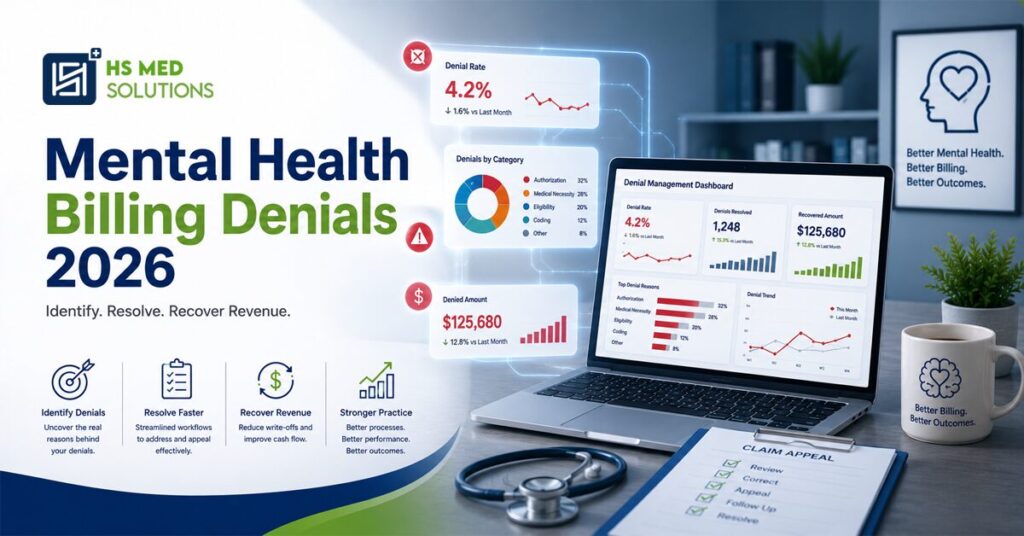
If you manage billing for a behavioral health practice, you already know the frustration. A claim goes out clean. Days later, an Explanation of Benefits comes back with a denial code instead of a payment. You investigate, find a fixable error, correct it, and resubmit. Then another denial comes in while you were working on the first one. And another. Mental health billing denials are not just an administrative annoyance. They represent real money that your practice earned and has not yet collected. For a practice billing one million dollars annually, a denial rate of 20 percent puts two hundred thousand dollars at risk every single year. Some of that comes back through diligent follow-up. Much of it does not, because most behavioral health practices lack the systematic process to pursue every denied claim before deadlines pass. This guide explains exactly why mental health billing denials happen, what the denial codes on your EOBs actually mean, how to appeal effectively, and what a real denial prevention system looks like in practice. Denials vs Rejections: Get This Right First Before anything else, understand the difference between a rejection and a denial. They look similar but require completely different responses, and confusing them wastes time. A rejection happens before the claim reaches the payer for adjudication. The clearinghouse or the payer’s front-end system kicks it back because something is structurally wrong, like a missing field, an invalid NPI, or a formatting error. Rejections do not generate an EOB. They show up in your clearinghouse reports with a reason code. Fix the error and resubmit the same claim. Rejections do not consume your timely filing window. A denial happens after the claim clears the front end and reaches adjudication. The payer reviewed it and decided, for some reason, not to pay it. Denials appear on an EOB with adjustment reason codes and remark codes. Denials do consume your timely filing window if you resubmit as a new claim rather than as a corrected claim. They also require a different response depending on the reason for the denial. This distinction matters because the right response to a CO-197 denial (missing authorization) is completely different from the right response to a CO-50 denial (medical necessity). Treating every denial the same way is one of the most common and most expensive mistakes behavioral health billing teams make. The Real Cost of Mental Health Billing Denials Behavioral health claims are denied at rates 85 percent higher than comparable medical claims, according to American Psychological Association research. The industry average denial rate for mental health claims sits between 15 and 20 percent nationally. In practices with high telehealth volume or complex payer mixes, rates can climb to 25 percent or more. Beyond the claim value itself, every denied claim costs approximately twenty-five dollars in additional staff labor to investigate, categorize, correct, and resubmit. Across a practice generating five hundred denials per month, that works out to more than twelve thousand dollars annually in rework cost, before accounting for the revenue those claims represent. There is also a less visible cost: staff morale and focus. When billing teams spend their time chasing denials reactively, they have less capacity for clean claim submission, proactive authorization management, and the eligibility verification work that prevents denials in the first place. Denial management can become a cycle that feeds itself when it is not properly organized. The good news is that appeals work. Research consistently shows that between 39 and 59 percent of appealed mental health billing denials result in payment when the appeal is properly documented and filed on time. The problem is that fewer than one percent of denied claims actually get appealed in most practices. That is not a reflection of the claims’ merit. It reflects a lack of process. Mental Health Billing Denial Codes What Your EOB Is Actually Telling You The Explanation of Benefits your practice receives after adjudication contains Claim Adjustment Reason Codes (CARCs) and Remittance Advice Remark Codes (RARCs). Together, these codes tell you exactly why the payer denied or adjusted the claim. Most billing teams know a handful of common codes. Understanding the full set specific to behavioral health allows you to categorize denials accurately and respond strategically. Export XLSExport CSV Code Who Sends It What It Means in Plain English Most Common Cause in Mental Health CO-4 Payer Procedure code is inconsistent with the modifier or service billed Wrong modifier for telehealth modality (95 applied to audio-only, or vice versa) CO-11 Payer Diagnosis code is inconsistent with the procedure billed Unspecified ICD-10 code used where a specific code is required by payer policy CO-16 Payer Claim lacks information or has a submission or billing error Missing NPI, missing authorization number, or incomplete claim fields CO-22 Payer This care may be covered by another payer per coordination of benefits Carve-out not identified; claim sent to wrong payer CO-29 Payer The time limit for filing the claim has expired Practice missed the timely filing window, often 90 days to 12 months CO-45 Payer Charge exceeds the fee schedule or maximum allowable amount Practice charged above contracted rate; typically adjusted automatically CO-50 Payer These are non-covered services because this is not deemed medically necessary Insufficient documentation of medical necessity in clinical notes CO-96 Payer Non-covered charge(s) Service not covered under the patient?s specific behavioral health benefit CO-97 Payer Payment adjusted because the benefit for this service is included in another service Psychotherapy add-on billed without a valid primary code on the same claim CO-197 Payer Precertification/authorization/notification absent Missing, expired, or incorrectly applied prior authorization number PR-1 Payer Deductible amount applied Not a denial; patient owes the deductible portion of the charge PR-2 Payer Coinsurance amount applied Not a denial; patient owes coinsurance OA-23 Payer The impact of prior payer(s) adjudication including payments and/or adjustments Secondary payer coordination issue; primary EOB not submitted correctly A few of these codes deserve specific attention in behavioral health. CO-50 and CO-197 are the two highest-revenue denial codes in most mental
Telehealth Mental Health Billing 2026

Telehealth has reshaped how mental health care reaches patients across the United States. Most behavioral health providers now deliver a significant share of their sessions remotely. Telehealth mental health billing carries its own coding rules, modifiers, and compliance requirements that differ from in-person billing. This guide explains exactly how to bill telehealth mental health services correctly in 2026. You will find place of service code rules, modifier guidance, Medicare flexibility updates, DEA prescribing requirements, and the most common errors that cause telehealth claims to deny. What Is Telehealth Mental Health Billing? Telehealth mental health billing is the process of submitting insurance claims for behavioral health services delivered remotely through video or audio technology. It uses the same core CPT codes as in-person psychotherapy and psychiatric services, with added place of service codes and modifiers that identify the visit as telehealth. Accurate telehealth billing requires three elements beyond standard mental health billing: the correct place of service code, the correct modality modifier, and documentation that supports the technology used and any required patient consent. Missing any of these elements is a leading cause of telehealth claim denials. Why Telehealth Mental Health Billing Differs From Other Telehealth Specialties Behavioral health occupies a uniquely stable position within Medicare telehealth policy. Congress passed permanent legislation in 2023 that protects behavioral health telehealth from the temporary extension cycle that governs most other specialties. For behavioral health specifically, three flexibilities are permanent under current law: the patient’s home may serve as the originating site, geographic restrictions have been removed, and audio-only delivery is permanently covered. Most non-behavioral telehealth services remain tied to recurring legislative extensions, currently running through December 31, 2027 under the Consolidated Appropriations Act of 2026. Understanding this distinction matters because many providers assume all telehealth coverage is temporary and at risk of expiring. Mental health providers can build long-term telehealth programs around the permanent behavioral health protections with real confidence. The Telehealth Mental Health Billing Process A correct telehealth billing workflow follows the same overall structure as in-person billing, with specific checkpoints added at each stage. Step 1: Verify Telehealth-Specific Insurance Benefits Confirm that the patient’s plan covers telehealth mental health services before scheduling the first virtual session. Some commercial plans apply different cost-sharing rules to telehealth visits. Medicaid telehealth coverage varies significantly by state, so always verify state-specific rules separately. Step 2: Confirm Technology and Patient Consent Document the technology used for the session and obtain any consent required by state law or payer policy. When a session is delivered audio-only, the clinical note should state that the provider had video capability available but that the patient declined or could not access video technology. Step 3: Select the Correct Place of Service Code Choose POS 10 when the patient is located at home, or POS 02 when the patient connects from any other location. This selection directly affects the reimbursement rate, so accuracy here protects practice revenue. Step 4: Apply the Correct Modifier Append modifier 95 for synchronous audio-video sessions or modifier 93 for synchronous audio-only sessions. Confirm payer-specific requirements, since some behavioral health claims may require modifier FQ instead of or alongside modifier 93. Step 5: Submit and Document the Claim Submit the claim with the standard psychotherapy or psychiatric CPT code, the correct POS code, and the correct modifier together. Keep documentation that supports medical necessity, session time, and the modality used in case of a payer audit. Place of Service Codes for Telehealth Mental Health Place of service codes tell the payer where the patient was physically located during the session. Selecting the wrong code is one of the most common and most costly telehealth billing errors. POS Code Description Patient Location Reimbursement Impact POS 10 Telehealth Provided in Patient?s Home Patient?s private residence Pays the non-facility rate (higher) POS 02 Telehealth Provided Other Than in Patient?s Home Clinic, school, workplace, or other non-home site Pays the facility rate (lower) Industry billing data suggests the reimbursement gap between POS 02 and POS 10 can reach approximately $42 per session for a 60-minute psychotherapy visit (CPT 90837) under Medicare. Across a busy caseload, consistently selecting the wrong POS code adds up to meaningful lost revenue over a year. Telehealth Modifiers for Mental Health Claims Modifiers tell the payer exactly how the session was delivered. Using the wrong modifier, or omitting one entirely, is a frequent cause of telehealth claim denials. Modifier Definition Typical Use Key Note 95 Synchronous telemedicine via real-time audio and video Standard video sessions across Medicare and most commercial payers Widely used; most practices append it on every video telehealth claim 93 Synchronous telemedicine via real-time audio only Phone-only sessions for Medicare and most commercial payers Required by Medicare on audio-only claims; missing it triggers denials FQ Audio-only behavioral health telemedicine Certain Medicare behavioral health claims and FQHC/RHC settings Payer-specific; confirm whether your payer wants FQ, 93, or both GT Synchronous audio-video via interactive telecom system Legacy modifier, retired for Medicare Part B in 2018 Survives only on Critical Access Hospital Method II claims GQ Asynchronous, store-and-forward communication FQHC/RHC settings only Rarely applicable to standard outpatient mental health billing Modifier requirements vary by payer more than almost any other billing element in mental health care. Build a payer-specific modifier reference into your billing workflow rather than assuming one rule applies universally. Synchronous Video vs Audio-Only Mental Health Telehealth Synchronous video sessions use modifier 95 and represent the majority of telehealth mental health visits. Audio-only sessions use modifier 93 and remain a permanently covered option for behavioral health under Medicare, regardless of broader telehealth policy changes. Audio-only billing carries a specific documentation expectation. The clinical note should confirm that the provider had audio-video capability available, and should state why the session proceeded audio-only, whether due to patient preference, lack of access to video technology, or another documented reason. Claims without this documentation are vulnerable to post-payment review. Why Medicare Rejects CPT Codes 98000-98015 The AMA introduced a new family of codes, 98000 through 98015, to modernize audio-only
Mental Health CPT Codes 2026

Mental health CPT codes are the foundation of behavioral health reimbursement. Every therapy session, psychiatric evaluation, family therapy visit, and crisis intervention requires a specific Current Procedural Terminology (CPT) code for insurance payment. Selecting the wrong code leads to claim denials, compliance risk, and lost revenue. This guide provides a complete reference to mental health CPT codes for 2026. You will find time-based coding rules, documentation requirements, Medicare reimbursement rates, and clear guidance for every major behavioral health CPT code. Whether you are a therapist, psychologist, psychiatrist, or billing professional, this reference will help you code more accurately and collect more revenue. What Are Mental Health CPT Codes? CPT codes are five-digit numeric codes published annually by the American Medical Association (AMA). They identify the specific clinical services a provider delivers during a patient encounter. Insurance companies, Medicare, and Medicaid use these codes to calculate reimbursement amounts and process claims. Mental health CPT codes cover the full range of behavioral health services. These include individual psychotherapy, psychiatric diagnostic evaluations, family therapy, group therapy, and crisis intervention. Each code carries documentation requirements, time rules, and reimbursement rates that vary by payer and geographic location. Behavioral health billing depends on accurate CPT codes more than nearly any other claim element. ICD-10-CM diagnosis codes establish medical necessity. The CPT code identifies the exact service delivered. Together, they determine whether a claim receives timely payment or results in a denial. How Time-Based Psychotherapy Codes Work Most individual psychotherapy CPT codes are time-based. The code you select must match the actual documented length of the clinical session. Time-based coding requires the provider to record the exact start time and stop time of every encounter. The three primary individual psychotherapy time ranges are: CPT 90832: For sessions lasting 16 to 37 minutes CPT 90834: For sessions lasting 38 to 52 minutes CPT 90837: For sessions lasting 53 minutes or more Sessions under 16 minutes typically do not meet the minimum threshold for a psychotherapy CPT code. Brief contacts at this length are better captured under evaluation and management codes when medically appropriate. Never round session times up to qualify for a higher-paying code. Billing 90837 for a documented 48-minute session is a coding error and a compliance violation. The selected code must always reflect the actual documented time. Payers audit time-based codes closely Complete Mental Health CPT Code Reference Table The following table covers all major mental health CPT codes for 2026. Medicare rates are approximate national averages. Rates vary by geographic location. Verify current rates through the CMS Physician Fee Schedule lookup tool. Export XLSExport CSV CPT Code Description Time Range Type Who Qualifies Avg. Medicare 90791 Psychiatric Diagnostic Evaluation 60+ min Primary All MH providers ~$162 90792 Psychiatric Diagnostic Eval. with Medical Services 60+ min Primary Psychiatrists/prescribers ~$228 90785 Interactive Complexity (Add-On) N/A Add-On All MH providers +~$21 90832 Psychotherapy, 30 Minutes 16-37 min Primary All MH providers ~$68 90833 Psychotherapy Add-On, 30 Min (to E/M) 16-37 min Add-On Psychiatrists only ~$65 90834 Psychotherapy, 45 Minutes 38-52 min Primary All MH providers ~$100 90836 Psychotherapy Add-On, 45 Min (to E/M) 38-52 min Add-On Psychiatrists only ~$97 90837 Psychotherapy, 60 Minutes 53+ min Primary All MH providers ~$134 90838 Psychotherapy Add-On, 60 Min (to E/M) 53+ min Add-On Psychiatrists only ~$131 90846 Family Psychotherapy, Without Patient Present 50+ min Primary All MH providers ~$100 90847 Family Psychotherapy, With Patient Present 50+ min Primary All MH providers ~$110 90853 Group Psychotherapy 45-90 min Primary All MH providers ~$35/member 90839 Crisis Psychotherapy, Initial 30-74 Minutes 30-74 min Primary All MH providers ~$197 90840 Crisis Psychotherapy, Each Additional 30 Minutes +30 min Add-On All MH providers ~$99 NOTE: Add-on codes (90785, 90833, 90836, 90838, 90840) cannot be billed independently. They must be paired with a primary CPT code. Add-on codes are indicated in the Type column above. Diagnostic Evaluation CPT Codes Diagnostic evaluation codes cover the comprehensive initial assessment of a new patient or a patient presenting with a new clinical concern. These codes represent the starting point for most behavioral health treatment relationships. CPT 90791: Psychiatric Diagnostic Evaluation Use CPT 90791 for a psychiatric diagnostic evaluation that does not include medical services. The provider conducts a thorough psychiatric history, evaluates current symptoms and functional status, and develops a diagnostic formulation and treatment plan. Psychologists, licensed professional counselors (LPCs), licensed clinical social workers (LCSWs), and marriage and family therapists (MFTs) most commonly use 90791 for initial intake appointments. This code reflects comprehensive clinical assessment without prescribing authority or medical decision-making. Required documentation for 90791: chief complaint and present illness, complete psychiatric history, past treatment history, substance use history, medical and family psychiatric history, a full mental status examination, diagnostic formulation using DSM or ICD criteria, and treatment recommendations with a clear treatment plan. Average Medicare reimbursement: approximately $162. CPT 90792: Psychiatric Diagnostic Evaluation with Medical Services Use CPT 90792 when the evaluation includes medical services such as prescribing medications, reviewing laboratory results, or exercising medical decision-making. Psychiatrists and other licensed prescribers primarily bill this code. Non-physician mental health providers cannot bill CPT 90792 under any circumstances. Billing 90792 as a psychologist or licensed counselor is a compliance violation. Providers must accurately reflect their scope of practice in code selection. Documentation for 90792 includes all elements of 90791 plus evidence of medical evaluation, medication review, prescribing rationale, and documentation of medical decision-making. Average Medicare reimbursement: approximately $228. Individual Psychotherapy CPT Codes (90832, 90834, and 90837) Individual psychotherapy codes cover one-on-one therapy sessions between a provider and their patient. Time documentation is essential for these codes. Document the exact start and stop times in every clinical note. CPT 90832: Psychotherapy, 30 Minutes (16-37 Minute Sessions) Bill CPT 90832 for individual psychotherapy sessions lasting between 16 and 37 minutes. This is the shortest billed psychotherapy session. Use 90832 for brief check-in sessions, crisis follow-up contacts that do not meet crisis code thresholds, or when session length is shortened due to patient factors. Do not assume that short sessions require 90832
Mental Health Billing Guide 2026

Mental health billing is one of the most complex areas in healthcare revenue cycle management. Behavioral health providers deal with unique coding rules, strict documentation requirements, and insurance policies that differ significantly from standard medical billing. Getting mental health billing right directly affects your practice revenue and your patients’ access to care. This guide covers everything you need to know about mental health billing in 2026. You will find CPT code explanations, insurance claim workflows, common billing errors, denial prevention strategies, and practical guidance for both psychiatry billing and psychology billing. What Is Mental Health Billing? Mental health billing is the process of submitting claims to insurance companies and collecting payment for behavioral health services. It covers the full revenue cycle from patient registration to final payment. Services billed under mental health billing include individual psychotherapy, psychiatric evaluations, family therapy, group therapy, and medication management. Behavioral health providers who bill insurance include psychiatrists, psychologists, licensed clinical social workers (LCSWs), licensed professional counselors (LPCs), marriage and family therapists (MFTs), and mental health clinics. Each provider type has specific billing rules based on their credentials and scope of practice. Professional mental health billing services manage all of these tasks on behalf of the provider. A skilled billing team helps practices increase collections, reduce denials, and stay compliant with changing payer requirements. Why Mental Health Billing Is Different From Medical Billing Mental health billing differs from standard medical billing in several important ways. Understanding these differences is essential for every behavioral health provider. Separate benefit structures: Most insurance plans separate mental health benefits from medical benefits. Some payers use behavioral health carve-outs. A carve-out means a completely different insurer manages the mental health claims. Providers must verify mental health benefits separately from medical benefits. Time-based CPT codes: Psychotherapy uses time-based CPT codes. The specific code you bill depends on the exact session length in minutes. Billing the wrong code for the documented session time is a common and costly error. Documentation requirements: Mental health claims require detailed clinical documentation. Payers want to see medical necessity justification, accurate ICD-10 diagnosis codes, treatment plan updates, and session notes that support the billed service. Prior authorization burden: Mental health services require pre-authorization more frequently than routine medical care. Authorizations also carry session limits that require ongoing tracking throughout the year. High denial rates: Behavioral health claims face denial rates of 15-20%, compared to 5-10% for general medical claims. Preventing and managing denials is a major focus of mental health billing. Credentialing complexity: Mental health providers must credential with each payer separately. Credentialing delays can hold up reimbursements by 60-90 days for new providers or when adding new payers. The Complete Mental Health Billing Process A successful mental health billing workflow follows a structured sequence of steps. Skipping any step increases the risk of denials, delays, and revenue loss. Step 1: Patient Eligibility Verification Eligibility verification is the first and most important step in the billing process. Before a patient’s first appointment, verify their insurance coverage specifically for mental health services. Confirm the following during every eligibility check: Active policy status Mental health benefit coverage (not just general medical coverage) In-network vs out-of-network status for behavioral health Remaining deductible and out-of-pocket amounts Copay and coinsurance requirements for mental health visits Annual session limits (some plans cap the number of covered psychotherapy visits) Carve-out information: which company actually manages the mental health benefits Many denials happen because providers skip this step or only check general medical benefits. Mental health benefits often carry different cost-sharing rules than medical benefits, even within the same insurance plan. Step 2: Prior Authorization Many insurance plans require prior authorization for mental health services. Requirements vary by payer and plan type. Some payers require authorization before the very first session. Others require it after a certain number of sessions. Follow this prior authorization workflow consistently: Identify whether the plan requires authorization for the requested service type. Gather clinical documentation that supports medical necessity for treatment. Submit the authorization request through the payer’s online portal or by phone. Record the authorization number, approved CPT codes, and session limits in your billing system. Track authorization expiration dates and request extensions at least two weeks before they expire. Document every authorization interaction, including dates, reference numbers, and staff contacted. Failing to obtain required authorization is one of the top denial reasons in mental health billing. A missed authorization can result in denying every session billed after the lapse. Step 3: Mental Health CPT Coding Accurate CPT coding is critical in mental health billing. Most psychotherapy codes are time-based. The code you select must reflect the actual documented length of the session. Document the exact start time and stop time of every clinical encounter. Rounding up session times to use a higher-paying code is a compliance violation and can trigger an audit. Always select the CPT code that matches the documented session length. Step 4: Claim Submission Submit claims within each payer’s timely filing deadline. Most payers set windows of 90 days to 12 months from the date of service. Missing a timely filing deadline results in automatic denial that cannot be appealed on clinical grounds. Include the following on every mental health claim: Rendering provider’s individual NPI (not only the group NPI) ICD-10-CM diagnosis codes that support medical necessity Correct CPT code with the actual documented session time Place of service code (11 for office, 02 for telehealth from a facility, 10 for telehealth at patient’s home) Modifier 95 for synchronous telemedicine services Authorization number when required by the payer Step 5: Payment Posting Post all payments, adjustments, and patient balances promptly after receiving an Explanation of Benefits (EOB) or Electronic Remittance Advice (ERA). Accurate payment posting helps you track collections and identify underpayments. Compare every payment against your contracted fee schedule. When a payer pays less than the contracted rate, you have grounds to appeal the underpayment. Many practices lose significant revenue by accepting underpayments without investigation. Step 6: Accounts Receivable Follow-Up Follow up on
Medical Billing Trends for 2026

Medical billing trends for 2026 are reshaping how healthcare providers manage revenue, file claims, and get paid. Artificial intelligence now handles tasks that once required hours of manual review. Value-based care models are replacing simple fee-for-service billing in many specialties. Meanwhile, claim denial rates have climbed to nearly 12 percent industry wide, according to recent HFMA research. Practices that understand these medical billing trends can protect cash flow and avoid costly denials. This guide breaks down the ten biggest shifts in medical billing trends for 2026. It also covers the challenges they create and how your practice can prepare. Industry Overview Medical billing has moved far beyond simple paperwork. Today it functions as the financial engine of every healthcare practice. Revenue cycle management now touches scheduling, coding, claims submission, and patient collections. As a result, billing teams must master coding accuracy, payer policy, and compliance all at once. The global medical billing outsourcing market reflects this shift. It is projected to grow from 15.61 billion dollars to 40.43 billion dollars by 2033. That growth signals how seriously providers now treat their revenue cycle. Understanding medical billing trends for 2026 helps practices plan staffing, technology, and partnerships before problems appear. Why Medical Billing Is Changing in 2026 Several forces are driving medical billing trends for 2026. First, payers continue tightening prior authorization and documentation rules. Second, patients now carry a larger share of their own healthcare costs. Therefore, billing teams must communicate balances clearly and offer flexible payment options. Third, federal policy keeps shifting. CMS finalized its CY 2026 Physician Fee Schedule with separate conversion factors for alternative payment model participants and standard clinicians. This change alone affects how every practice calculates expected reimbursement. Meanwhile, staffing shortages push more practices toward automation and outsourced billing support. Together, these pressures explain why 2026 feels like a turning point rather than a routine update. Top Medical Billing Trends for 2026 The following ten medical billing trends for 2026 stand out as the most influential. Each one affects claim accuracy, cash flow, or patient experience in a measurable way. Artificial Intelligence in Medical Billing Artificial intelligence has moved past the pilot stage. In 2026, AI tools now flag coding errors before claims leave the building. They also predict which claims are likely to be denied. According to Guidehouse research, AI-powered coding support ranked as the top revenue cycle priority for medical groups this year. As a result, billing teams catch mistakes earlier and resubmit claims faster. However, AI still needs human oversight to interpret nuanced clinical documentation correctly. Predictive Analytics Predictive analytics gives billing teams a head start. Instead of reacting to denials, practices can now anticipate them. For example, software can flag a claim likely to fail eligibility checks before submission. Consequently, staff fix the issue early instead of waiting on a rejection. This shift saves time and protects monthly revenue projections. Automated Claims Processing Automated claims processing reduces the manual work behind every submission. Systems now auto-populate codes, verify modifiers, and check payer-specific rules in seconds. Furthermore, automation catches formatting errors that often cause instant rejections. Practices that adopt this technology typically see faster turnaround and fewer resubmissions. Still, automation works best when paired with experienced billing staff who can review edge cases. Revenue Cycle Automation Revenue cycle automation extends beyond claims into scheduling, eligibility, and collections. Tools now sync directly with electronic health records to reduce duplicate data entry. As a result, fewer claims get delayed due to mismatched patient information. Additionally, automated reminders help patients pay balances before accounts reach collections. This connected approach keeps the entire revenue cycle moving smoothly. Patient Payment Technology Patients now expect the same payment experience they get from retail apps. Mobile-friendly portals, text-to-pay links, and saved payment methods are becoming standard. Therefore, practices that modernize patient payment technology collect balances faster. In addition, transparent cost estimates before treatment reduce billing disputes later. This trend matters because patient responsibility now makes up a larger share of total revenue than it did five years ago. Real-Time Eligibility Verification Real-time eligibility verification confirms coverage before a patient even reaches the front desk. This prevents the common problem of treating a patient under the wrong plan. Moreover, real-time checks reduce claim denials tied to inactive coverage or missing authorization. Practices that verify eligibility at every visit, not just the first one, see noticeably cleaner claims. Value-Based Care Billing Value-based care billing ties payment to patient outcomes rather than visit volume. This model requires different documentation, coding, and reporting than fee-for-service billing. Consequently, practices entering value-based contracts need billing staff trained specifically for these arrangements. CMS continues expanding Alternative Payment Models and MIPS Value Pathways, which makes this trend harder to ignore in 2026. Data Security and Compliance Billing data security has become a board-level concern, not just an IT issue. Practices handle protected health information across more systems and vendors than ever before. As a result, HIPAA compliance now extends to every clearinghouse, portal, and automation tool in the billing chain. Strong access controls and regular audits help practices avoid costly breaches and penalties. Telehealth Billing Evolution Telehealth billing keeps evolving as coverage rules shift year to year. CMS extended waivers allowing rural health clinics and federally qualified health centers to bill for telehealth through 2026. Additionally, virtual presence now satisfies direct supervision requirements in many settings. Therefore, practices offering virtual care need billing staff who track these changes closely and apply the correct codes and modifiers. Outsourced Medical Billing Growth Outsourced medical billing continues its steady climb. Many practices simply lack the staff to track every payer update and coding change. Therefore, they turn to specialized billing partners who focus on this work full time. This trend connects directly to the challenges below, since outsourcing addresses many of them directly. Challenges Healthcare Providers Will Face These medical billing trends for 2026 bring real challenges alongside their benefits. Claim denial rates remain stubbornly high, with industry estimates near 12 percent. Meanwhile, staffing shortages make it harder to
Cardiology Claim Denial Management

Cardiology claim denial management is one of the most financially critical functions in any cardiology practice. Cardiology consistently records the highest denial rates of all outpatient specialties, between 15 and 20 percent of submitted claims, compared to a 5 to 10 percent cross-specialty average. Furthermore, according to MGMA 2024 benchmarking data, more than half of all U.S. healthcare organizations report denial rates exceeding 10 percent, with appeal management ranked among the most resource-intensive revenue cycle functions in the entire practice. The cost of poor cardiology denial management goes far beyond individual denied claims. Specifically, each denied claim costs an average of 25 to 35 dollars in staff time to work and appeal. Moreover, research consistently shows that up to 50 percent of denied claims are never resubmitted at all making unworked denials one of the largest sources of permanent revenue loss in cardiology. For a mid-size cardiology practice generating two million dollars annually, that represents 100,000 to 160,000 dollars in avoidable losses every year. This guide provides a complete, actionable framework for cardiology claim denial management. It covers the full denial lifecycle from root-cause analysis through structured appeals, explains the most common cardiology denial reason codes, establishes KPI benchmarks your practice should track, and outlines the prevention workflows that high-performing practices use to keep denial rates below five percent. Whether you manage billing in-house or work with professional cardiology billing services, this guide gives your team the tools to stop denials before they happen and recover revenue when they do. Practices that already follow a comprehensive cardiology medical billing guide can often reduce denial rates before they become a major revenue issue. Understanding the Cardiology Claim Denial Lifecycle Effective cardiology claim denial management starts with understanding the full denial lifecycle. A denial does not begin when a claim is rejected. It begins at the moment a billing or clinical workflow error is introduced, which is often days or weeks before the claim is even submitted. Therefore, managing denials effectively requires interventions at every stage of the revenue cycle, not just at the back end. The Five Stages of a Cardiology Denial Stage What Happens Where Denial Risk Enters 1 – Pre-Service Patient registration, eligibility verification, prior authorization Demographic errors, missing PA, inactive coverage 2 – Point of Care Clinical service delivery, documentation, charge capture Incomplete notes, missed charges, undocumented medical necessity 3 – Claim Preparation CPT and ICD-10 coding, modifier assignment, claim scrubbing Incorrect codes, missing modifiers, NCCI bundling errors 4 – Claim Submission Electronic submission to payer via clearinghouse Timely filing errors, rejected claim format, missing data elements 5 – Post-Submission Payer adjudication, denial receipt, appeal, resolution Wrong denial category worked, expired appeal window, no root-cause fix Furthermore, industry data shows that approximately 50 percent of cardiology claim denials originate in Stages 1 and 2, before any coding or billing action occurs. Consequently, cardiology denial prevention is primarily a front-end and clinical challenge, not only a billing team problem. Practices that treat denial management as exclusively a back-end billing function will always fight the same denials month after month. Specifically, the Journal of AHIMA reports that hospitals using feedback-driven appeal processes shortened denial resolution times by 28 percent while improving overall claim accuracy across high-value service lines including cardiology. Therefore, building a feedback loop from post-denial analysis back into pre-service workflows is the single most powerful structural improvement a cardiology practice can make. HS MED Solutions tip: At the start of each engagement, we conduct a full denial lifecycle audit for every new cardiology client. This audit identifies exactly which stage produces the most denials, and consequently, where process improvements deliver the highest financial return. Top Cardiology Denial Reason Codes and What They Mean Every denied cardiology claim carries a Claim Adjustment Reason Code (CARC) and a Remittance Advice Remark Code (RARC). These codes tell your billing team precisely why the payer denied the claim. Therefore, reading and categorizing denial codes is the foundation of any effective cardiology claim denial management program. Without this step, your team is guessing at root causes and applying the wrong fixes. The Five Core Denial Categories in Cardiology Denial Category Common CARC Codes Cardiology-Specific Trigger Preventable? Prior Authorization / Medical Necessity 4, 15, 197 Nuclear stress tests, PCI, advanced echo, CCTA Yes – 95%+ with correct PA workflow Coding and Modifier Errors 4, 16, 97, 151 Missing vessel modifiers on PCI, 93000+93010 dual-billing, deleted 2026 PCI codes Yes – NCCI scrubber + modifier rules sheet Eligibility and Coverage 27, 29, 31, 291 Expired Medicare Advantage plan, wrong subscriber ID, inactive commercial policy Yes – real-time eligibility check at every visit Duplicate Billing 18, 97 Bundled echo/stress codes billed separately, AFib ablation + EP study on same date Yes – automated claim scrubber Timely Filing 29, 31 Delayed charge capture, manual billing workflows Yes – 72-hour charge entry and submission policy Documentation / Medical Necessity 50, 55, 56, M86 Complete TTE billed without all required views documented, nuclear SPECT missing segmental report Yes – procedure documentation checklists High-Value Cardiology Procedures Most Frequently Denied Not all cardiology denials carry equal financial weight. Specifically, the following procedure categories generate the most revenue-impactful denials in cardiology practices. Therefore, your denial management team should prioritize these categories in work queues and monitoring: Nuclear stress tests (78451, 78452): Prior authorization failures and medical necessity documentation gaps are the top denial drivers. Cardiac catheterization (93451–93461): Incorrect level of service selection and missing coronary angiography documentation cause most cath lab denials. PCI (92920–92945): 2026 code restructuring specifically, use of deleted add-on codes is now the leading PCI denial trigger. Echocardiography (93306, 93308): Overcoding limited echo as complete is the most common documentation-based denial in outpatient cardiology. Electrophysiology ablation (93656): Billing EP evaluation separately from AFib ablation creates bundling denials on virtually every claim. Remote physiologic monitoring (99454, 99470): Missing patient consent, monitoring dates, or documented data review produces widespread RPM denials. Cardiology denial management requires a procedure-specific approach. A generic denial workflow treats a PCI authorization denial the same as
Common Cardiology Billing Errors: How to Avoid Costly Claim Denials

Common cardiology billing errors are costing U.S. cardiology practices millions of dollars every year in denied claims, delayed reimbursements, and compliance risks. According to the 2023 MGMA report, coding errors generated $68 billion in annual denied claim losses across U.S. healthcare providers. Cardiology practices lose 5–8% of collectible revenue due to billing mistakes and claim denials. These losses build up silently over time. Eventually, they can threaten the financial stability of the entire practice. Cardiology billing mistakes are not always the result of negligence. Often, they stem from the sheer complexity of cardiovascular coding. A single patient encounter can generate multiple high-value CPT codes, require payer-specific prior authorization, and demand meticulous documentation to satisfy medical necessity criteria. Therefore, even experienced billing teams make errors that trigger denials when they lack cardiology-specific training. This guide identifies the ten most common cardiology billing errors that practices across the United States face. Furthermore, it explains exactly why each error happens, what it costs your practice, and what your billing team should do to prevent it. Whether you manage billing in-house or partner with cardiology billing services, understanding these errors is the first step toward protecting your revenue. Practices that already follow a comprehensive cardiology medical billing guide can often reduce denial rates before they become a major revenue issue. Why Accurate Cardiology Billing Matters More Than Ever Cardiology practices operate under more billing scrutiny than almost any other specialty in the United States. Specifically, cardiology claim denial rates run between 15 and 20 percent, far above the 5 to 10 percent average across all specialties. Furthermore, MGMA data from 2025 confirms that operating costs for medical groups rose more than 11 percent, while reimbursement rates remained largely flat. In that financial environment, billing errors are not minor inefficiencies. They are direct threats to practice viability. Additionally, the administrative cost of correcting billing errors compounds the financial damage. Appealing a single denied claim costs a practice an average of 25 to 35 dollars in staff time. Multiply that across hundreds of monthly denials in a busy cardiology practice, and the operational burden becomes significant. Moreover, up to 50 percent of denied claims are never resubmitted at all, according to MGMA benchmarks. Consequently, every denied claim that goes unworked represents permanent revenue loss. The good news is that most common cardiology billing errors are preventable. Specifically, the 2023 MGMA report found that 42 percent of cardiology denials link directly to missing documentation or modifier errors, two problems that process improvement and coder training can address systematically. Therefore, identifying and eliminating these errors is not just a billing goal. It is a strategic financial priority for every cardiology practice. HS MED Solutions has helped cardiology practices across the United States reduce their denial rates from above 15 percent to below 5 percent through specialty-specific billing workflows, quarterly coding audits, and proactive denial management. Contact us at info@hsmedsolutions.com or 845-481-1953 to schedule a free billing analysis. Top Common Cardiology Billing Errors and How to Fix Them 1. Incorrect CPT Code Selection Incorrect CPT coding is the single most frequent cause of cardiology claim denials. Specifically, cardiology covers more than 200 procedure-specific CPT codes across echocardiography, stress testing, cardiac catheterization, electrophysiology, and interventional procedures. Selecting a code that does not precisely match the documented service, even by one digit, triggers an immediate denial or a payment at the wrong rate. Furthermore, 2026 brought major CPT restructuring in the PCI category. Six branch vessel add-on codes were permanently deleted, and two new codes (92930 and 92945) were introduced. Practices that have not updated their charge master for 2026 are submitting incorrect codes on every PCI claim they file this year. Consequently, outdated code sets are one of the fastest ways a high-volume cardiology practice loses revenue. ✔ Update your charge master, EHR code library, and coder reference sheets every January 1. Subscribe to AMA CPT update notifications and American College of Cardiology coding corner alerts to stay current throughout the year. Additionally, review our full cardiology CPT codes reference guide for 2026 code changes. 2. Missing or Insufficient Documentation Documentation gaps are the leading cause of post-payment audit failures in cardiology. Specifically, the 2023 MGMA report attributes 42 percent of all cardiology claim denials to missing documentation or modifier errors. A chart that looks complete to a clinician may still fall short of what a payer’s medical reviewer needs to approve reimbursement. For high-value cardiology procedures, documentation standards are strict. A complete transthoracic echocardiogram (CPT 93306) requires all standard cardiac views with chamber measurements. A nuclear stress test (CPT 78452) requires documentation of the injection protocol, stress type, tracer used, and all 17 myocardial segments. A cardiac catheterization report must include pre-procedure evaluation, contrast usage, and detailed procedural findings. Therefore, if any of these elements are missing, the claim is vulnerable, not just to denial but to post-payment recovery demands. ⚠ Do not code ahead of documentation. If a physician’s note does not support a complete study, bill the lower-level code that the documentation does support. Overcoding is a compliance risk, not just a billing error. 3. Upcoding and Downcoding Upcoding means billing a higher-level service than the documentation supports. Downcoding means billing below the documented level of service. Both are problems, though for different reasons. Upcoding creates fraud and abuse exposure and triggers payer audits. Downcoding, on the other hand, leaves legitimate reimbursement uncollected, a common issue in cardiology practices where billers are overly conservative to avoid audit risk. In echocardiography, the difference between a limited study (CPT 93308) and a complete study (CPT 93306) represents a significant reimbursement gap. Billing 93308 when the documentation supports 93306 is a real form of revenue loss. Conversely, billing 93306 when only a limited study was performed and documented is upcoding. Therefore, coders must evaluate every cardiology encounter against actual documentation, not against what the cardiologist typically performs or what reimburses at a higher rate. ✔ Implement a documentation checklist for high-value cardiology procedures. The checklist should specify exactly which
Cardiology CPT Codes Guide 2026: The Complete Reference for Cardiology Practices

Cardiology CPT codes are the foundation of every reimbursement claim your practice submits. Selecting the wrong code on a cardiac catheterization or echocardiography claim costs your practice real money. As a result, cardiology billing teams, practice managers, and cardiologists all need a reliable, up-to-date reference that goes beyond a simple list. This guide covers every major category of cardiology billing codes, explains how to use them correctly, and highlights every critical 2026 update that affects your claims starting January 1, 2026. Furthermore, 2026 brought the most significant cardiology coding changes in more than a decade. Specifically, the AMA issued 288 new codes, deleted 84 codes, and revised 46 code descriptions across the CPT manual. PCI codes changed completely. A new AI-assisted imaging code gained Category I status. Remote monitoring rules expanded. Therefore, practices that have not updated their charge master and coder training for 2026 are already submitting incorrect claims. Additionally, this guide covers cardiology CPT codes across all major procedure categories: ECG, echocardiography, stress testing, cardiac catheterization, percutaneous coronary intervention, electrophysiology, pacemakers and devices, nuclear cardiology, coronary CT angiography, and remote physiologic monitoring. Each section also includes the most common billing errors and the documentation your team needs to support every claim. HS MED Solutions has provided specialized cardiology medical billing services for more than 25 years, and consequently, every recommendation in this guide reflects real-world billing experience across all cardiology subspecialties. Understanding the Cardiology CPT Code Framework Before using specific cardiology CPT codes, your billing team needs to understand how the AMA organizes cardiovascular procedure codes. The primary cardiovascular range runs from 92920 to 93799. However, cardiology billing codes also appear in radiology (75571 to 75577 for coronary CT), nuclear medicine (78451 to 78499), and surgery sections for device implantation. Therefore, a cardiologist’s charge ticket may pull from four separate CPT sections on a single day. Specifically, the AMA groups cardiovascular CPT codes into these primary categories: Why Modifier Knowledge Is Inseparable from CPT Code Knowledge Cardiology CPT codes almost always require modifiers to specify how a service was delivered. Modifier 26 indicates the professional component only, meaning the cardiologist provided interpretation but not technical performance. The modifier TC covers the technical component only. Modifier 59 identifies distinct procedural services performed on the same day. The vessel modifiers LD, LC, RC, LM, and RI are required on every PCI claim to identify the treated coronary artery. Therefore, selecting the correct cardiology billing code without the correct modifier produces a claim that pays at the wrong rate or is denied completely. Furthermore, NCCI edits define which cardiology procedure codes can be billed together and which are considered bundled. CMS updates these edits quarterly. Consequently, billing teams must review NCCI edit updates every quarter and adjust claim submission logic when bundling rules change for high-volume cardiology codes. HS MED Solutions Tip: We run every cardiology claim through an automated NCCI edit scrubber before submission. This single step prevents the majority of bundling denials that cardiology practices experience from in-house billing teams. Electrocardiography CPT Codes 93000 to 93042 ECG codes are the most frequently billed cardiology billing codes in outpatient practice. They are also the most frequently miscoded because three distinct scenarios exist: the complete service, the technical component only, and the professional component only. Specifically, the scenario depends on who performs the ECG and who interprets it. CPT Code Description Correct Billing Scenario 93000 ECG with at least 12 leads complete service (tracing + interpretation + report) One provider performs AND interprets the ECG in the same setting 93005 ECG tracing and recording only a technical component Technician performs the tracing; a separate provider interprets 93010 ECG interpretation and report only professional component A cardiologist interprets an ECG performed at a different facility; do not add modifier 26 93040 Rhythm ECG with interpretation and report Shorter rhythm strip for arrhythmia monitoring includes interpretation 93041 Rhythm ECG tracing only Technical component for rhythm strip interpreter bills 93042 separately 93042 Rhythm ECG interpretation and report only Professional component for rhythm strip pair with 93041 from the technical site The Most Common ECG Billing Error Audit Alert: Never bill 93000 and 93010 on the same claim for the same patient on the same date. Code 93000 already includes the interpretation component. Billing both creates a duplicate billing error and triggers an automatic NCCI denial. Additionally, modifier 26 should never be appended to code 93010, because 93010 is already the professional-component-only code. Furthermore, if your practice bills ECGs performed in your office but sent to a remote cardiologist for interpretation, split the billing correctly. Bill 93005 (technical component) from the office and 93010 (professional component) from the interpreting cardiologist. This split-billing scenario is common in multi-site and telehealth cardiology arrangements and represents one of the most audited ECG billing patterns. Echocardiography CPT Codes 93303 to 93356 Echocardiography cardiology billing codes carry some of the highest audit rates among all cardiovascular procedure codes. Specifically, payers scrutinize echo claims because the difference between a complete study (93306) and a limited study (93308) represents a meaningful reimbursement gap. Therefore, documentation must clearly support whichever echocardiography code your practice submits. Transthoracic Echocardiography (TTE) Codes CPT Code Description Documentation Required 93306 Complete TTE with spectral and color Doppler All cardiac structures, chamber measurements, and Doppler flows in every standard view must be documented 93307 Complete TTE without Doppler Same structural documentation as 93306, no Doppler component billed 93308 Follow-up or limited TTE Specific clinical indication required, do not routinely downcode from 93306 93312 Transesophageal echo (TEE) complete Full image acquisition, probe insertion, interpretation report, all views required 93314 TEE image acquisition only (technical component) Use when the cardiologist interprets separately bill 93316 for the professional component 93316 TEE interpretation and report only (professional component) Pair with 93314 from the technical site 93350 Stress echo rest and exercise or pharmacologic stress Document stress protocol, rest, and stress images are both required 93351 Stress echo with contrast Same as 93350, also document the contrast agent used and the clinical indication