
Mental health billing is one of the most complex areas in healthcare revenue cycle management. Behavioral health providers deal with unique coding rules, strict documentation requirements, and insurance policies that differ significantly from standard medical billing. Getting mental health billing right directly affects your practice revenue and your patients’ access to care.
This guide covers everything you need to know about mental health billing in 2026. You will find CPT code explanations, insurance claim workflows, common billing errors, denial prevention strategies, and practical guidance for both psychiatry billing and psychology billing.
What Is Mental Health Billing?
Mental health billing is the process of submitting claims to insurance companies and collecting payment for behavioral health services. It covers the full revenue cycle from patient registration to final payment. Services billed under mental health billing include individual psychotherapy, psychiatric evaluations, family therapy, group therapy, and medication management.
Behavioral health providers who bill insurance include psychiatrists, psychologists, licensed clinical social workers (LCSWs), licensed professional counselors (LPCs), marriage and family therapists (MFTs), and mental health clinics. Each provider type has specific billing rules based on their credentials and scope of practice.
Professional mental health billing services manage all of these tasks on behalf of the provider. A skilled billing team helps practices increase collections, reduce denials, and stay compliant with changing payer requirements.
Why Mental Health Billing Is Different From Medical Billing
Mental health billing differs from standard medical billing in several important ways. Understanding these differences is essential for every behavioral health provider.
- Separate benefit structures: Most insurance plans separate mental health benefits from medical benefits. Some payers use behavioral health carve-outs. A carve-out means a completely different insurer manages the mental health claims. Providers must verify mental health benefits separately from medical benefits.
- Time-based CPT codes: Psychotherapy uses time-based CPT codes. The specific code you bill depends on the exact session length in minutes. Billing the wrong code for the documented session time is a common and costly error.
- Documentation requirements: Mental health claims require detailed clinical documentation. Payers want to see medical necessity justification, accurate ICD-10 diagnosis codes, treatment plan updates, and session notes that support the billed service.
- Prior authorization burden: Mental health services require pre-authorization more frequently than routine medical care. Authorizations also carry session limits that require ongoing tracking throughout the year.
- High denial rates: Behavioral health claims face denial rates of 15-20%, compared to 5-10% for general medical claims. Preventing and managing denials is a major focus of mental health billing.
- Credentialing complexity: Mental health providers must credential with each payer separately. Credentialing delays can hold up reimbursements by 60-90 days for new providers or when adding new payers.
The Complete Mental Health Billing Process
A successful mental health billing workflow follows a structured sequence of steps. Skipping any step increases the risk of denials, delays, and revenue loss.
Step 1: Patient Eligibility Verification
Eligibility verification is the first and most important step in the billing process. Before a patient’s first appointment, verify their insurance coverage specifically for mental health services.
Confirm the following during every eligibility check:
- Active policy status
- Mental health benefit coverage (not just general medical coverage)
- In-network vs out-of-network status for behavioral health
- Remaining deductible and out-of-pocket amounts
- Copay and coinsurance requirements for mental health visits
- Annual session limits (some plans cap the number of covered psychotherapy visits)
- Carve-out information: which company actually manages the mental health benefits
Many denials happen because providers skip this step or only check general medical benefits. Mental health benefits often carry different cost-sharing rules than medical benefits, even within the same insurance plan.
Step 2: Prior Authorization
Many insurance plans require prior authorization for mental health services. Requirements vary by payer and plan type. Some payers require authorization before the very first session. Others require it after a certain number of sessions.
Follow this prior authorization workflow consistently:
- Identify whether the plan requires authorization for the requested service type.
- Gather clinical documentation that supports medical necessity for treatment.
- Submit the authorization request through the payer’s online portal or by phone.
- Record the authorization number, approved CPT codes, and session limits in your billing system.
- Track authorization expiration dates and request extensions at least two weeks before they expire.
- Document every authorization interaction, including dates, reference numbers, and staff contacted.
Failing to obtain required authorization is one of the top denial reasons in mental health billing. A missed authorization can result in denying every session billed after the lapse.
Step 3: Mental Health CPT Coding
Accurate CPT coding is critical in mental health billing. Most psychotherapy codes are time-based. The code you select must reflect the actual documented length of the session.
Document the exact start time and stop time of every clinical encounter. Rounding up session times to use a higher-paying code is a compliance violation and can trigger an audit. Always select the CPT code that matches the documented session length.
Step 4: Claim Submission
Submit claims within each payer’s timely filing deadline. Most payers set windows of 90 days to 12 months from the date of service. Missing a timely filing deadline results in automatic denial that cannot be appealed on clinical grounds.
Include the following on every mental health claim:
- Rendering provider’s individual NPI (not only the group NPI)
- ICD-10-CM diagnosis codes that support medical necessity
- Correct CPT code with the actual documented session time
- Place of service code (11 for office, 02 for telehealth from a facility, 10 for telehealth at patient’s home)
- Modifier 95 for synchronous telemedicine services
- Authorization number when required by the payer
Step 5: Payment Posting
Post all payments, adjustments, and patient balances promptly after receiving an Explanation of Benefits (EOB) or Electronic Remittance Advice (ERA). Accurate payment posting helps you track collections and identify underpayments.
Compare every payment against your contracted fee schedule. When a payer pays less than the contracted rate, you have grounds to appeal the underpayment. Many practices lose significant revenue by accepting underpayments without investigation.
Step 6: Accounts Receivable Follow-Up
Follow up on all unpaid claims at the 30-day mark. Do not wait until claims are 60 or 90 days old before contacting payers. Early follow-up shortens your revenue cycle and reduces write-offs.
Prioritize follow-up by claim age and dollar amount. High-value, older claims deserve the most attention first. Set a consistent weekly schedule for AR review so no claim falls through the cracks.
Step 7: Denial Management
Review every denied claim promptly. Identify the denial reason code on the EOB or ERA. Correct any errors and resubmit within the payer’s appeal deadline. Document all appeal activity carefully.
The most common mental health claim denial reasons include:
- Missing or expired prior authorization
- Incorrect CPT code for the documented session time
- Medical necessity not clearly established in documentation
- Credentialing issue (provider not yet enrolled with the payer)
- Duplicate claim submission
- Timely filing violation
- Incorrect place of service code for telehealth visits
Mental Health CPT Codes Explained
The following CPT codes are the most frequently used in outpatient mental health billing and psychiatry billing. Each code has specific documentation requirements and session time ranges. Always document session start and stop times clearly in your clinical notes.
| CPT Code | Description | Session Length | Who Bills It | Avg. Medicare |
|---|---|---|---|---|
| 90791 | Psychiatric Diagnostic Evaluation | 60+ minutes | All providers | ~$162 |
| 90792 | Psychiatric Diagnostic Evaluation with Medical Services | 60+ minutes | Psychiatrists | ~$228 |
| 90832 | Psychotherapy, 30 Minutes | 16-37 minutes | All providers | ~$68 |
| 90834 | Psychotherapy, 45 Minutes | 38-52 minutes | All providers | ~$100 |
| 90837 | Psychotherapy, 60 Minutes | 53+ minutes | All providers | ~$134 |
| 90846 | Family Psychotherapy Without Patient Present | 50+ minutes | All providers | ~$100 |
| 90847 | Family Psychotherapy With Patient Present | 50+ minutes | All providers | ~$110 |
- CPT 90791 (Psychiatric Diagnostic Evaluation): Use 90791 for the initial evaluation without medical services. The provider reviews psychiatric history, current symptoms, and relevant background. This code does not include prescribing or medical decision-making. Psychologists, counselors, and therapists most commonly use this code for intake appointments.
- CPT 90792 (Psychiatric Diagnostic Evaluation with Medical Services): Use 90792 when the evaluation includes medical services such as prescribing, reviewing lab results, or complex medical decision-making. This code is primarily for psychiatrists and other prescribing providers. Non-physician mental health providers cannot bill 90792.
- CPT 90832 (Psychotherapy 30 Minutes): Bill 90832 when the session time is between 16 and 37 minutes. This is the shortest psychotherapy code. It is appropriate for brief check-in sessions or when time is limited due to patient circumstances.
- CPT 90834 (Psychotherapy 45 Minutes): Bill 90834 when the session time falls between 38 and 52 minutes. This is the most commonly billed psychotherapy code and reflects the standard 45-to-50-minute therapy session.
- CPT 90837 (Psychotherapy 60 Minutes): Bill 90837 when the session time is 53 minutes or longer. This code carries the highest reimbursement among standard individual psychotherapy codes. Documentation must clearly support the extended session length.
- CPT 90846 (Family Psychotherapy Without Patient Present): Use 90846 when the therapist meets with family members only, without the identified patient present. The session focuses on education, communication strategies, or treatment coordination.
- CPT 90847 (Family Psychotherapy With Patient Present): Use 90847 when both the patient and family members participate together in the session. This code reimbursed slightly higher than 90846 and requires documentation of the patient’s active participation.
Common Mental Health Billing Challenges
Mental health providers face billing challenges that differ from other medical specialties. Knowing these challenges in advance allows you to build systems that prevent them.
- Behavioral health carve-outs: Many insurance plans use separate organizations to manage mental health benefits. Submitting claims to the wrong payer entity wastes time and delays revenue. Always confirm carve-out arrangements during eligibility verification.
- Session limits and authorization tracking: Many plans cap the number of covered sessions per year. Providers must track authorizations, session counts, and expiration dates. When a patient approaches their limit, notify them before coverage runs out and request an extension if medically necessary.
- Telehealth billing complexities: Telehealth mental health services remain popular in 2026. Billing these services requires the correct place of service codes and modifiers. POS 02 applies when the patient is in a facility. POS 10 applies when the patient is at home. Modifier 95 indicates synchronous telemedicine.
- Credentialing delays: New providers often wait 60-90 days for payer credentialing to complete. Submitting claims before credentialing is finalized results in denial. Plan ahead and submit credentialing applications early to prevent revenue gaps.
- HIPAA compliance requirements: All mental health billing must comply with HIPAA regulations. This includes secure transmission of electronic claims, protection of patient health information, and proper documentation standards.
- EAP billing: Employee Assistance Program (EAP) billing follows different rules than commercial insurance. EAP sessions often have separate session limits and different authorization requirements. Track EAP sessions separately from insurance-covered sessions.
Psychiatry Billing vs Psychology Billing
Psychiatry billing and psychology billing share many similarities. However, key differences in provider credentials and scope of practice affect how each specialty codes and bills for services.
Psychiatric Billing and Coding
Psychiatrists are medical doctors who specialize in mental health. They can prescribe medications, order labs, and perform comprehensive medical evaluations. This expands the CPT codes available to them beyond standard psychotherapy codes.
Psychiatry billing commonly includes:
- CPT 90792 for diagnostic evaluations with medical services
- Evaluation and Management (E/M) codes 99202-99215 for medication management visits
- Add-on code 90833 (psychotherapy add-on to E/M, 30 minutes) billed alongside E/M codes
- Inpatient psychiatric billing codes 99221-99223 for initial hospital care
- Subsequent hospital care codes 99231-99233 for ongoing inpatient management
Inpatient psychiatric billing requires documentation of medical necessity for continued inpatient stay. Each subsequent hospital care visit must clearly support the need for inpatient-level care. Psychiatric billing services should employ coders familiar with both E/M coding and psychotherapy coding, since psychiatrists frequently bill both service types on the same date.
Billing for Psychologists
Psychologists hold doctoral degrees (PhD or PsyD) and specialize in psychological assessment and therapy. In most states, they are not medical doctors and cannot prescribe medications. This difference limits the CPT codes available to them.
Medical billing for psychologists focuses primarily on:
- CPT 90791 for intake and diagnostic evaluations
- CPT 90832, 90834, and 90837 for individual psychotherapy
- CPT 90846 and 90847 for family therapy
- Neuropsychological testing codes 96130-96136 for comprehensive evaluations
Psychology medical billing requires careful attention to session time documentation and to the exact scope of practice authorized in your state. Psychologists cannot bill 90792 or E/M codes in most jurisdictions. Billing for services outside your licensed scope is a compliance violation.
Mental Health Billing Errors That Reduce Revenue
Billing errors cost behavioral health practices thousands of dollars every year. The following errors appear most frequently in mental health billing audits. Addressing each one directly strengthens your revenue cycle.
- Wrong CPT code for session time: Billing 90837 when the documented session is only 45 minutes is a coding error. The documentation must support 53 or more minutes to bill 90837. Always document the exact start and stop times and select the code that matches.
- Missing prior authorization: Submitting a claim without a required prior authorization results in automatic denial. Verify authorization requirements before delivering any service and track every authorization number in your system.
- Incorrect place of service for telehealth: Using the wrong place of service code for remote visits causes denials. Confirm whether the patient is in a healthcare facility (POS 02) or at home (POS 10) before submitting each telehealth claim.
- Billing with group NPI only: Payers require the rendering provider’s individual NPI on the claim. Submitting only the group NPI causes claim rejections. Include both the individual NPI (box 24J) and the group NPI (box 33a) on the CMS-1500.
- Vague ICD-10 codes: Using unspecified diagnosis codes (such as F41.9 for unspecified anxiety) can trigger medical necessity reviews. Code as specifically as the clinical documentation supports. Use more specific codes whenever possible.
- Duplicate claim submissions: Resubmitting a claim without verifying the status of the original submission can result in duplicate claim denials. Check claim status before resubmitting and use the correct resubmission code when required.
- Late claim filing: Missing the timely filing deadline is an automatic denial that cannot be appealed on clinical merit. Know each payer’s timely filing window and submit claims promptly after each date of service.
- Incorrect session type for family therapy: Billing 90847 when the patient was not present, or 90846 when the patient was present, results in denials or audits. Document clearly who was present in every family therapy session.
Mental Health Billing Services vs In-House Billing
| Factor | In-House Billing | Mental Health Billing Services |
|---|---|---|
| Staff Cost | $35,000-$55,000/year per biller (salary + benefits) | 6-12% of net collections |
| Expertise | Limited to individual staff training | Specialized behavioral health knowledge |
| Technology | Practice buys and maintains software | Included with the service |
| Scalability | Difficult as patient volume grows | Scales with your volume automatically |
| Denial Management | Often reactive and inconsistent | Proactive, systematic, and tracked |
| Compliance | Dependent on staff keeping up with changes | Maintained continuously by specialists |
| Reporting | Basic reporting only | Detailed revenue cycle analytics |
| Focus | Staff split between billing and admin duties | Dedicated focus on your revenue cycle |
Most small to mid-size behavioral health practices achieve better financial results by outsourcing mental health billing. The cost savings from reduced denials and improved collections typically exceed the service fee. Additionally, outsourcing allows clinical staff to focus entirely on patient care rather than administrative tasks.
How Mental Health Billing Services Improve Revenue
Professional mental health billing services improve practice revenue in several specific and measurable ways.
First, they verify insurance benefits correctly before every appointment. This prevents service delivery to patients without adequate mental health coverage. Second, they submit clean claims on the first attempt, which reduces denials by 15-25% compared to in-house billing averages.
Additionally, billing services track all authorizations and alert providers before sessions expire. They follow up on all unpaid claims within 30 days of submission. Furthermore, they appeal denials systematically using clinical knowledge and payer-specific appeal strategies. This recovers revenue that in-house teams frequently write off as uncollectable.
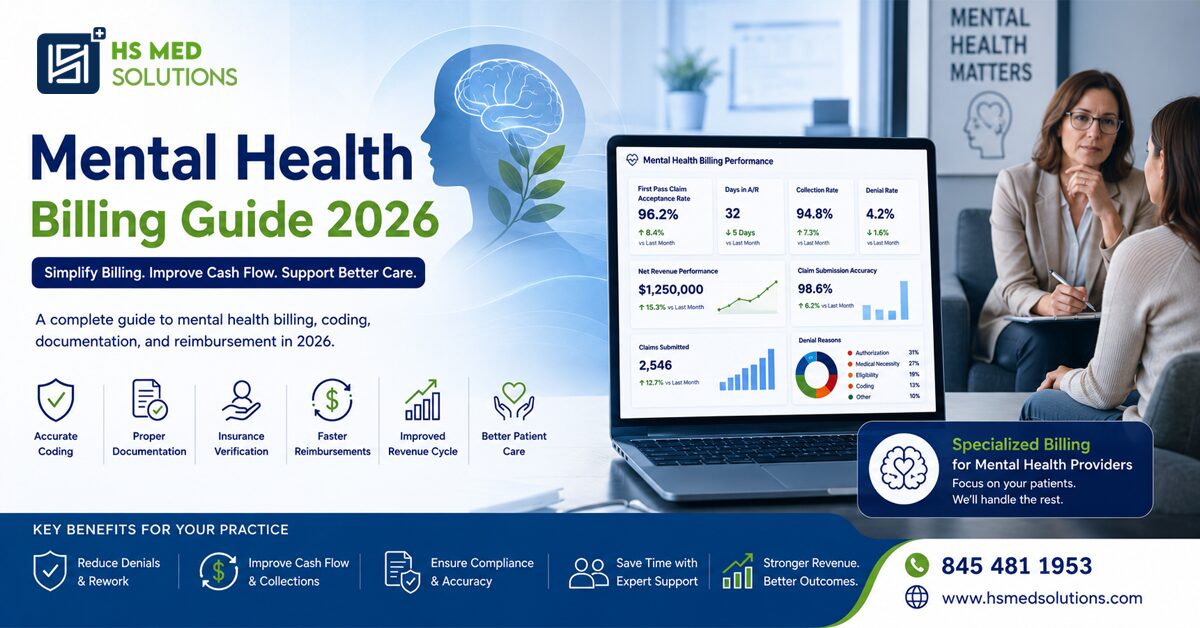
A well-managed mental health billing workflow typically achieves:
- First-pass claim acceptance rates above 95%
- Denial rates below 5%
- Days in accounts receivable below 35 days
- Net collection rates above 95%
- Timely filing violation rate near zero
Choosing The Right Mental Health Billing Company
Not all billing companies have the expertise needed for behavioral health claims. When evaluating mental health billing companies, ask each candidate these specific questions:
- Do you specialize in behavioral health and mental health billing, or is it one segment of a larger general practice?
- What EHR and practice management systems do you integrate with directly?
- What is your average first-pass claim acceptance rate for mental health clients?
- How do you manage prior authorization tracking and expiration alerts?
- Do you handle telehealth billing, including place of service codes and modifiers?
- What is your process for appealing denied mental health claims?
- What reports will I receive, at what frequency, and in what format?
- What is your fee structure: percentage of collections, flat fee, or hybrid?
- Are you fully HIPAA-compliant, and can you provide documentation of your compliance practices?
- What is your average days in AR for behavioral health clients currently?
A qualified mental health billing company should answer every one of these questions with specific, measurable responses. Vague answers signal a lack of specialized expertise.
Mental Health Billing Service Costs
Mental health billing services typically charge a percentage of net collections. This percentage usually ranges from 6% to 12%, depending on several factors:
- Practice size and monthly claim volume
- Services included (credentialing, auth management, patient statements, collections)
- EHR integration complexity and data migration requirements
- Specialty mix (psychiatry generally requires more complex coding than counseling)
Some billing companies offer flat monthly fees instead of a percentage model. Flat fees work well for high-volume practices with predictable monthly revenue. Percentage-based pricing aligns the billing company’s financial incentives directly with your collections.
Always request a detailed scope of services in your billing contract. Understand exactly which tasks are included in the base fee and which services carry additional charges. Credentialing, patient billing, and authorization management are sometimes priced separately.
Why Healthcare Providers Outsource Mental Health Billing
Healthcare providers outsource mental health billing for practical, measurable reasons. The primary driver is billing complexity. Mental health billing rules change frequently. Payer policies vary significantly across commercial insurers, Medicare, and Medicaid. Keeping up with these changes is itself a full-time job.
Outsourcing also allows providers to focus fully on clinical care. Many therapists, psychologists, and psychiatrists report reduced administrative stress and improved work-life balance after delegating billing to a professional team. Burnout is a serious issue among mental health providers. Reducing administrative burden makes a real difference.
Finally, outsourcing provides access to better billing technology. Medical billing for mental health services requires robust practice management software, electronic eligibility verification tools, and clearinghouse connectivity. Billing companies invest in these systems and distribute the cost across their client base, making enterprise-level technology available to practices of every size.
How HS MED Solutions Supports Mental Health Providers
HS MED Solutions provides medical billing for mental health services across all behavioral health specialties. With over 25 years of revenue cycle management experience, our team understands the specific demands of psychiatry billing, psychology medical billing, and counseling services billing.
Our mental health billing solutions include:
- Insurance eligibility verification with dedicated mental health benefit checks
- Prior authorization management, tracking, and renewal alerts
- Accurate CPT coding for psychotherapy, psychiatric evaluations, and family therapy
- Electronic claim submission through HIPAA-compliant clearinghouse connections
- Payment posting and remittance reconciliation
- Proactive denial management and appeals resolution
- Systematic accounts receivable follow-up on all outstanding claims
- Credentialing and payer enrollment services
- Detailed monthly reporting on all key revenue cycle metrics
Whether you operate a solo private practice or a multi-provider behavioral health clinic, HS MED Solutions offers mental health billing programs designed to increase your collections and reduce your administrative burden. Contact us today to learn how we can improve your revenue cycle.
Future of Mental Health Billing Beyond 2026
Several emerging trends will shape mental health billing in the years ahead. Understanding these trends now helps practices prepare for what is coming.
- AI-assisted billing tools: Artificial intelligence is improving claim scrubbing and denial prediction. AI tools can identify potential errors before claim submission, reducing denial rates further. Billing companies that invest in AI-powered tools will deliver better results for their clients.
- Value-based care models: Payers are beginning to experiment with outcome-based payment models for behavioral health. This shift will require new documentation and outcome reporting capabilities. Practices should start tracking treatment outcomes now to prepare for these payment models.
- Stronger parity enforcement: Federal and state regulators are intensifying MHPAEA enforcement. Insurers face increasing pressure to expand behavioral health coverage. This creates more billing opportunities but also more scrutiny of claims for medical necessity.
- Permanent telehealth coverage: Remote mental health services are now a permanent part of the healthcare landscape. Future billing rule changes around telehealth will require ongoing education. Billing teams must stay current on evolving payer policies for telehealth.
- Workforce expansion: The behavioral health workforce is growing rapidly. More licensed counselors, social workers, and psychiatric nurse practitioners are entering practice. This increases billing volume and creates more opportunities for specialized billing services.
Practices that invest in strong mental health billing processes today will be well-positioned to grow their revenue as the behavioral health sector expands. Partnering with an experienced billing company is one of the most effective ways to prepare for this growth.
Frequently Asked Questions About Mental Health Billing
Mental health billing is the process of submitting insurance claims and collecting payment for behavioral health services. It includes eligibility verification, prior authorization, CPT coding, claim submission, payment posting, denial management, and accounts receivable follow-up.
The most common psychotherapy CPT codes are 90832 (30 minutes, 16-37 minute sessions), 90834 (45 minutes, 38-52 minute sessions), and 90837 (60 minutes, 53+ minute sessions) for individual therapy. Family therapy uses 90846 (without the patient present) and 90847 (with the patient present).
Mental health billing uses time-based CPT codes, requires separate insurance benefit verification, involves higher prior authorization requirements, and follows specific documentation rules not found in standard medical billing. Behavioral health claims also face higher denial rates than general medical claims.
It depends on the insurance plan. Many plans require prior authorization for mental health services, especially for ongoing therapy after the initial sessions. Always verify authorization requirements during eligibility checks. Never assume authorization is not required.
Timely filing limits vary by payer. Most commercial payers allow 90 days to 12 months from the date of service. Medicare requires claims within one calendar year. Medicaid limits vary by state. Always confirm each payer's specific deadline and submit claims promptly to avoid automatic denials.
No. CPT 90792 is reserved for providers who can deliver medical services, typically psychiatrists and other licensed prescribers. Psychologists use CPT 90791 for diagnostic evaluations in most states. Check your state's scope of practice rules for any exceptions.
Telehealth mental health sessions use the same CPT codes as in-person visits. Add the appropriate place of service code: POS 02 when the patient is at a healthcare facility and POS 10 when the patient is at home. Add modifier 95 to indicate synchronous telemedicine delivery. Check each payer's telehealth policy for additional requirements.
Medicare reimburses approximately $134 for CPT 90837 (60-minute psychotherapy). Commercial payer rates vary by contract and geography but typically range from $100 to $200 per session. Some private payers reimburse significantly higher than Medicare rates.
To reduce mental health claim denials: verify benefits before every appointment, obtain all required authorizations, document exact session start and stop times, use the correct time-based CPT codes, include the rendering provider's individual NPI, and submit claims within the timely filing window. Proactive denial prevention is far more efficient than reactive appeals.
Mental health billing services typically charge 6-12% of net collections. Exact pricing depends on practice size, monthly claim volume, services included, and specialty complexity. Some companies offer flat monthly fees for high-volume practices. Always request a detailed scope of services before signing any billing contract.
Yes. Psychiatrists can bill both an E/M code (such as 99214) and a psychotherapy add-on code (90833 for 30 additional minutes of therapy) on the same date of service. Both services must be medically necessary and documented separately. The E/M covers medication management, and 90833 covers the additional psychotherapy component.
If a patient exceeds their authorized sessions without a new authorization, the payer will deny all subsequent claims. Notify the patient before they reach the session limit. Submit a new authorization request at least two weeks before the current authorization expires. Document all authorization requests and approvals carefully.