
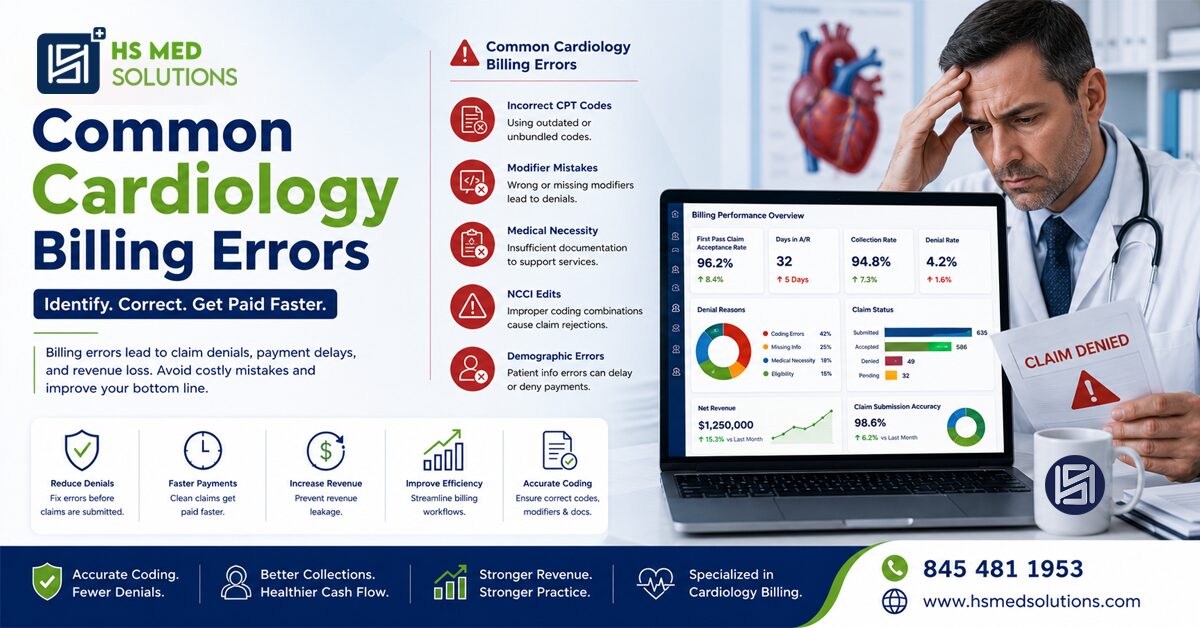
Common cardiology billing errors are costing U.S. cardiology practices millions of dollars every year in denied claims, delayed reimbursements, and compliance risks. According to the 2023 MGMA report, coding errors generated $68 billion in annual denied claim losses across U.S. healthcare providers. Cardiology practices lose 5–8% of collectible revenue due to billing mistakes and claim denials. These losses build up silently over time. Eventually, they can threaten the financial stability of the entire practice.
Cardiology billing mistakes are not always the result of negligence. Often, they stem from the sheer complexity of cardiovascular coding. A single patient encounter can generate multiple high-value CPT codes, require payer-specific prior authorization, and demand meticulous documentation to satisfy medical necessity criteria. Therefore, even experienced billing teams make errors that trigger denials when they lack cardiology-specific training.
This guide identifies the ten most common cardiology billing errors that practices across the United States face. Furthermore, it explains exactly why each error happens, what it costs your practice, and what your billing team should do to prevent it. Whether you manage billing in-house or partner with cardiology billing services, understanding these errors is the first step toward protecting your revenue.
Practices that already follow a comprehensive cardiology medical billing guide can often reduce denial rates before they become a major revenue issue.
Why Accurate Cardiology Billing Matters More Than Ever
Cardiology practices operate under more billing scrutiny than almost any other specialty in the United States. Specifically, cardiology claim denial rates run between 15 and 20 percent, far above the 5 to 10 percent average across all specialties. Furthermore, MGMA data from 2025 confirms that operating costs for medical groups rose more than 11 percent, while reimbursement rates remained largely flat. In that financial environment, billing errors are not minor inefficiencies. They are direct threats to practice viability.
Additionally, the administrative cost of correcting billing errors compounds the financial damage. Appealing a single denied claim costs a practice an average of 25 to 35 dollars in staff time. Multiply that across hundreds of monthly denials in a busy cardiology practice, and the operational burden becomes significant. Moreover, up to 50 percent of denied claims are never resubmitted at all, according to MGMA benchmarks. Consequently, every denied claim that goes unworked represents permanent revenue loss.
The good news is that most common cardiology billing errors are preventable. Specifically, the 2023 MGMA report found that 42 percent of cardiology denials link directly to missing documentation or modifier errors, two problems that process improvement and coder training can address systematically. Therefore, identifying and eliminating these errors is not just a billing goal. It is a strategic financial priority for every cardiology practice.
Top Common Cardiology Billing Errors and How to Fix Them
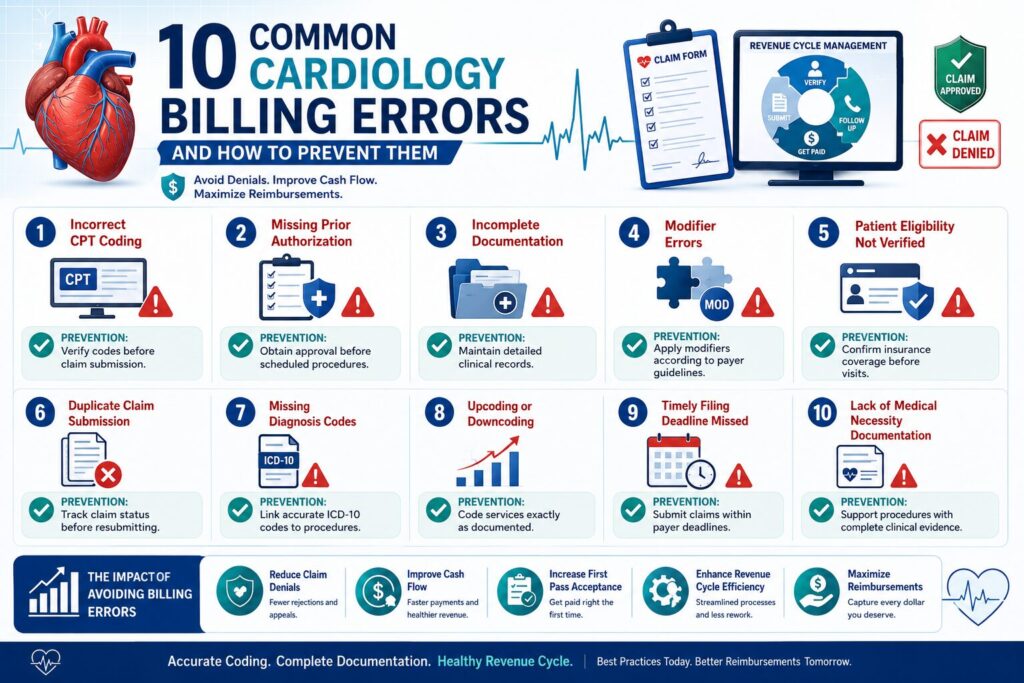
1. Incorrect CPT Code Selection
Incorrect CPT coding is the single most frequent cause of cardiology claim denials. Specifically, cardiology covers more than 200 procedure-specific CPT codes across echocardiography, stress testing, cardiac catheterization, electrophysiology, and interventional procedures. Selecting a code that does not precisely match the documented service, even by one digit, triggers an immediate denial or a payment at the wrong rate.
Furthermore, 2026 brought major CPT restructuring in the PCI category. Six branch vessel add-on codes were permanently deleted, and two new codes (92930 and 92945) were introduced. Practices that have not updated their charge master for 2026 are submitting incorrect codes on every PCI claim they file this year. Consequently, outdated code sets are one of the fastest ways a high-volume cardiology practice loses revenue.
2. Missing or Insufficient Documentation
Documentation gaps are the leading cause of post-payment audit failures in cardiology. Specifically, the 2023 MGMA report attributes 42 percent of all cardiology claim denials to missing documentation or modifier errors. A chart that looks complete to a clinician may still fall short of what a payer’s medical reviewer needs to approve reimbursement.
For high-value cardiology procedures, documentation standards are strict. A complete transthoracic echocardiogram (CPT 93306) requires all standard cardiac views with chamber measurements. A nuclear stress test (CPT 78452) requires documentation of the injection protocol, stress type, tracer used, and all 17 myocardial segments. A cardiac catheterization report must include pre-procedure evaluation, contrast usage, and detailed procedural findings. Therefore, if any of these elements are missing, the claim is vulnerable, not just to denial but to post-payment recovery demands.
3. Upcoding and Downcoding
Upcoding means billing a higher-level service than the documentation supports. Downcoding means billing below the documented level of service. Both are problems, though for different reasons. Upcoding creates fraud and abuse exposure and triggers payer audits. Downcoding, on the other hand, leaves legitimate reimbursement uncollected, a common issue in cardiology practices where billers are overly conservative to avoid audit risk.
In echocardiography, the difference between a limited study (CPT 93308) and a complete study (CPT 93306) represents a significant reimbursement gap. Billing 93308 when the documentation supports 93306 is a real form of revenue loss. Conversely, billing 93306 when only a limited study was performed and documented is upcoding. Therefore, coders must evaluate every cardiology encounter against actual documentation, not against what the cardiologist typically performs or what reimburses at a higher rate.
4. Duplicate Billing
Duplicate billing occurs when the same service receives two separate claim submissions. In cardiology, this happens most often in two specific scenarios. First, practices bill both the complete service code and the component codes simultaneously, for example, billing CPT 93000 (complete ECG) and CPT 93010 (ECG interpretation only) on the same claim for the same patient. Second, multi-provider practices submit claims for the same procedure from two different providers without realizing both claims cover the same service.
Additionally, bundled cardiology services create duplicate billing traps. For instance, stress echocardiography code 93351 includes the stress test component. Billing 93015 (cardiovascular stress test) alongside 93351 on the same date is a bundling error that generates an automatic NCCI denial. Similarly, AFib ablation code 93656 includes the EP evaluation, billing 93619 or 93620 on the same date creates a duplicate claim.
5. Eligibility Verification Errors
Up to 50 percent of cardiology claim denials originate from front-end errors before a single procedure is performed. Specifically, incorrect patient demographics, misspelled names, wrong dates of birth, incorrect subscriber numbers, or outdated insurance ID numbers, trigger immediate claim rejections that delay revenue by weeks. For high-value cardiology claims such as PCI or advanced echocardiography, even minor demographic mismatches can result in thousands of dollars in revenue delays.
Furthermore, eligibility verification is not a one-time task at registration. Insurance coverage changes frequently. A patient who was active under a commercial plan at their last appointment may have switched to Medicare Advantage or a different plan by their next visit. Therefore, cardiology practices should verify eligibility at every encounter, not just on new patient appointments.
6. Modifier Mistakes
Modifier errors are one of the most expensive and most preventable common cardiology billing errors. In cardiology, modifiers define the difference between billing the professional component only (modifier 26), the technical component only (modifier TC), or the complete service. They also identify distinct procedures on the same date (modifier 59 and X modifiers) and the specific coronary vessel treated during PCI (modifiers LD, LC, RC, LM, RI). An incorrect or missing modifier changes the reimbursement amount, triggers a bundling denial, or causes a vessel-specific claim rejection on every PCI claim submitted.
Specifically, one of the most frequent modifier errors in cardiology is appending modifier 26 to CPT 93010. Code 93010 is already the professional-component-only code for ECG interpretation. Adding modifier 26 to it is redundant and creates a billing error. Additionally, failing to append the correct vessel modifier on PCI claims is an automatic Medicare denial. Furthermore, missing modifier 59 when billing two distinct cardiology procedures on the same date leads to NCCI bundling rejections that pay only the higher-value code.
7. Incorrect ICD-10 Diagnosis Coding
Every cardiology CPT code must pair with an ICD-10-CM diagnosis code that establishes medical necessity for the procedure performed. Payers use automated logic to evaluate whether the submitted diagnosis code justifies the procedure billed. When the diagnosis does not support the service, the claim denies for lack of medical necessity, regardless of how correctly the CPT code was selected.
Specifically, submitting a stress test (CPT 93015) with only a screening or wellness diagnosis code will produce a routine medical necessity denial. The supporting ICD-10 code must reflect a clinical condition, such as chest pain (R07.9), known coronary artery disease (I25.10), or shortness of breath (R06.09), that explains why the test was ordered. Furthermore, cardiology patients frequently have multiple comorbidities including diabetes, chronic kidney disease, and hypertension. CMS data shows that failing to code documented comorbidities reduces average payment per encounter by 9 to 12 percent. Therefore, complete and specific ICD-10 coding is both a compliance requirement and a revenue protection strategy.
8. Untimely Claim Submission
Every payer imposes timely filing deadlines for claim submission. Medicare requires claims within 12 months of the service date. Most commercial payers impose deadlines of 90 to 180 days. Missing a timely filing deadline produces a denial that is almost always non-appealable, meaning the revenue is permanently lost regardless of how accurate the claim was.
In busy cardiology practices, untimely filing typically results from a specific workflow failure: charge capture delays. When procedure notes are not signed promptly, charges are not entered into the billing system, and claims are not submitted within the required window. Furthermore, practices that rely on manual charge capture are significantly more vulnerable to timely filing failures than those using integrated EHR and billing platforms that automate charge entry from clinical documentation.
9. Failure to Follow Payer-Specific Guidelines
Commercial payers, Medicare, Medicaid, and Medicare Advantage plans each maintain distinct coverage policies, prior authorization requirements, and billing rules for cardiology services. A billing practice that works perfectly for Medicare may produce denials on every claim submitted to a specific commercial plan. Consequently, cardiology billing teams must maintain a current, payer-specific policy reference not rely on a single billing approach across all plans.
Prior authorization is one of the most consequential payer-specific requirements. A 2023 MGMA study found that 25 percent of all cardiology denials resulted from missing or incomplete prior authorizations. For interventional procedures, nuclear stress tests, and advanced echocardiography, many payers require PA before the service is performed. Performing a procedure without a valid prior authorization produces a non-covered denial that is typically impossible to appeal. Moreover, Medicare Advantage plans frequently impose PA requirements that traditional Medicare does not, and these requirements vary by plan even within the same geographic region.
10. Poor Follow-Up on Denied Claims
Denied claims do not become paid claims on their own. They require systematic follow-up, accurate appeal documentation, and resubmission within the payer’s appeal window. Specifically, every denial has a root cause, a missing modifier, a documentation gap, an expired timely filing window, or a missing prior authorization, and fixing the root cause is the only way to convert a denial into payment.
However, many cardiology practices treat denied claims reactively rather than systematically. Billing staff work denials in the order they appear rather than by dollar value, age, or appeal deadline. Additionally, practices that lack a structured denial analysis workflow miss the pattern-level insight they need to prevent future denials of the same type. Furthermore, claims that sit in denial status beyond the appeal window are lost permanently. Therefore, a proactive denial management workflow is not optional, it is a core component of effective cardiology medical billing.
How Cardiology Billing Errors Impact Practice Revenue
The financial impact of common cardiology billing errors is both direct and compounding. Directly, every denied claim represents revenue your practice has already earned but not yet collected. Indirectly, the staff time spent working denials, resubmitting corrected claims, and managing aging AR represents an operational cost that reduces the net revenue generated by every clinical encounter.
| Billing Error Category | Average Revenue Impact | Prevention Difficulty |
|---|---|---|
| Incorrect CPT coding | High downcoding reduces reimbursement per claim; upcoding creates audit liability | Medium requires ongoing coder training and code set updates |
| Missing documentation | High audit recovery demands can retroactively reverse payments | Medium requires documentation templates and physician education |
| Prior authorization failure | Very High non-covered denials are typically non-appealable | Low systematic PA workflow prevents nearly all PA denials |
| Modifier errors | Medium to High modifier omission triggers bundling or component errors | Low modifier rules sheet addresses most recurring errors |
| Eligibility/demographic errors | Medium correctable but delay payment by 2 to 4 weeks | Low real-time eligibility verification at check-in |
| Untimely filing | Very High 100% revenue loss with no appeal option | Low daily charge capture and submission workflow |
| ICD-10 mismatch | Medium medical necessity denials require documentation review to appeal | Medium complete diagnosis coding at time of encounter |
| Duplicate billing | Medium claims denied or reduced; repeat offenses trigger payer audits | Low NCCI scrubber catches most bundling conflicts before submission |
Furthermore, the cumulative effect of multiple billing errors is more damaging than any single error in isolation. Specifically, a cardiology practice with a 15 percent denial rate, a 50 percent denial follow-up rate, and a 10 percent timely filing miss rate is not just losing revenue on individual claims. It is systematically under-collecting on a significant share of every clinical dollar generated.
According to industry benchmarks, cardiology practices that operate without specialty-specific billing oversight typically collect between 85 and 90 cents of every earned dollar. Practices that implement systematic denial management, regular coding audits, and payer-specific workflows collect 95 to 98 cents of every earned dollar. Therefore, the revenue gap between a poorly managed billing operation and a well-managed one represents hundreds of thousands of dollars annually for a mid-size cardiology practice.
Best Practices to Prevent Common Cardiology Billing Errors
Preventing cardiology billing mistakes requires a structured approach that addresses every stage of the revenue cycle, from patient registration through final payment posting. Therefore, the following best practices represent the most impactful changes a cardiology practice can implement to reduce denials and protect revenue.
Front-End Prevention Strategies
- Verify insurance eligibility and benefits in real time at every patient encounter not just at initial registration.
- Confirm prior authorization status for all procedures requiring PA before the patient arrives for the appointment.
- Collect accurate patient demographics at registration and verify them against payer records before submitting any claim.
Clinical Documentation Strategies
- Provide cardiologists with procedure-specific documentation checklists that list every element required to support each high-value CPT code.
- Require same-day or next-day note completion for all high-value procedures including echocardiograms, stress tests, and cardiac catheterizations.
- Train physicians to document all comorbidities that influence treatment not just the primary cardiac diagnosis to prevent ICD-10 mismatch denials and optimize risk-adjusted reimbursement.
- Conduct quarterly physician documentation audits to identify recurring documentation gaps before they become a pattern of denials.
Coding and Claims Submission Strategies
- Update the charge master, EHR code library, and coder reference materials every January 1 for new AMA CPT updates and every October 1 for ICD-10 changes.
- Run all claims through an automated NCCI edit scrubber and payer-specific logic rules before electronic submission.
- Require a secondary coder review on all high-value cardiology claims above a threshold dollar amount typically 500 dollars or more.
- Maintain a modifier quick reference guide specific to your practice’s top cardiology CPT codes and update it when payer rules change.
Denial Management Strategies
- Track every denial by reason code, payer, provider, and procedure type using your practice management system’s denial reporting module.
- Work all denials within 48 hours of receipt prioritizing by dollar amount and appeal deadline.
- Conduct a monthly denial root-cause meeting with billing staff to identify systemic errors and implement process fixes.
- Monitor accounts receivable aging weekly. Specifically, flag any claim approaching the payer’s timely filing deadline for immediate action.
The Role of Professional Cardiology Billing Services
Many cardiology practices reach a point where the complexity of their billing operation exceeds the capacity of their in-house team. Specifically, managing 200-plus cardiology CPT codes, tracking quarterly NCCI edit updates, maintaining payer-specific PA matrices, and working denied claims systematically requires dedicated cardiology billing expertise that most general medical billing staff do not have.
Professional cardiology billing services provide that expertise at scale. Furthermore, a specialized billing partner brings economies of scale dedicated cardiology coders, automated claim scrubbing technology, structured denial management workflows, and compliance monitoring that most individual practices cannot replicate internally. As a result, practices that outsource cardiology billing to a specialized partner consistently achieve lower denial rates, faster payment cycles, and higher net collection rates than comparable practices managing billing in-house.
However, not all medical billing companies are equal. A generalist billing company that handles primary care, orthopedics, and cardiology with the same team is unlikely to deliver the same results as a company with dedicated cardiology coding specialists. Therefore, when evaluating cardiology billing services, specialty experience is the most important criterion. Ask specifically how many active cardiology clients the company serves, what subspecialties they cover, and whether their coders hold CPC or CCC credentials.
| Evaluation Criteria | What to Ask a Cardiology Billing Partner |
|---|---|
| Cardiology specialization | How many active cardiology practices do you currently serve? What subspecialties? |
| Coder credentials | Do your billing team members hold CPC or CCC (Certified Cardiology Coder) credentials? |
| 2026 CPT updates | How did you update your workflows for the 2026 PCI code restructuring? |
| Denial management | What is your average denial rate across cardiology clients? How do you work denials? |
| Reporting | What monthly reports do you provide? Do they break down denials by payer and procedure? |
| HIPAA compliance | How do you handle cardiology billing data? Are your data practices HIPAA Security Rule compliant? |
| Prior authorization | Do you manage prior authorizations as part of your cardiology billing service? |
| Contract terms | What are your termination terms? Do you require a long-term commitment? |
Cardiology Billing Error Prevention Checklist
Use this checklist to audit your current cardiology billing workflows. Each item that your practice cannot check off represents a specific vulnerability in your revenue cycle that a billing error can exploit.
Before Every Patient Appointment
- Confirm active insurance coverage and verify eligibility through payer portal or real-time verification tool.
- Identify whether the scheduled procedure requires prior authorization from this patient’s specific plan.
- Confirm that a valid prior authorization is on file before the patient arrives.
- Verify patient demographics match insurance records exactly name spelling, date of birth, subscriber ID.
At the Time of Service
- Cardiologist completes the procedure note on the same day as the service.
- Note documents all required elements for the specific CPT code that will be billed.
- All comorbidities addressed or affecting treatment are documented with specific ICD-10 codes.
At the Time of Billing
- Correct CPT code selected based on documented service not on what was intended or typically performed.
- All required modifiers applied correctly especially vessel modifiers on PCI claims.
- CPT and ICD-10 codes reviewed for medical necessity alignment before claim submission.
- Claim scrubbed against NCCI edits and payer-specific bundling rules before electronic submission.
- Claim submitted within 72 hours of service date.
After Claim Submission
- Daily monitoring of claim status in payer portal or clearinghouse.
- Every denial worked within 48 hours of receipt.
- Monthly denial pattern review conducted with billing team.
- Accounts receivable aging report reviewed weekly claims approaching filing deadlines flagged immediately.
Common Cardiology Billing Errors: Frequently Asked Questions
The most common cardiology billing errors are incorrect CPT code selection, missing or insufficient documentation, modifier mistakes, failure to obtain prior authorization, and untimely claim submission. Additionally, ICD-10 and CPT code mismatches that fail medical necessity review are among the leading causes of denial. According to the 2023 MGMA report, 42 percent of cardiology denials link directly to documentation gaps or modifier errors making these two categories the highest priority for prevention.
Cardiology practices typically lose 5 to 8 percent of collectible revenue to billing errors, coding mistakes, and unworked denials. For a cardiology practice generating 2 million dollars annually, that represents 100,000 to 160,000 dollars in annual revenue loss. Furthermore, coding errors generated 68 billion dollars in denied claim losses across U.S. healthcare in 2023, according to MGMA data. The financial impact extends beyond individual denied claims to include staff time spent on appeals, delayed cash flow, and the permanent loss of claims that are never resubmitted or appealed past the deadline.
Preventing prior authorization denials requires a systematic front-end workflow. Specifically, every cardiology procedure on the practice's service list should be cross-referenced against each payer's PA requirement before any appointment is scheduled. Furthermore, practices should maintain a payer-specific PA matrix that documents authorization requirements, submission processes, turnaround times, and appeal procedures for every plan in the practice's payer mix. A 2023 MGMA study found that 25 percent of cardiology denials result from missing or incomplete prior authorizations a category that a well-designed PA workflow can eliminate almost entirely.
Upcoding means submitting a CPT code for a higher-level service than the documentation supports for example, billing CPT 93306 (complete echocardiogram) when documentation only supports CPT 93308 (limited echocardiogram). Upcoding creates fraud and abuse exposure and attracts payer audits. Downcoding means billing below the documented level of service for example, billing 93308 when a complete study was performed and fully documented. Downcoding leaves legitimate reimbursement uncollected. Both are cardiology billing errors. The correct approach is to always code to the level of service that the clinical documentation actually supports no higher, no lower.
Cardiology practices face denial rates of 15 to 20 percent because cardiology billing is objectively more complex than most specialties. Specifically, cardiology involves more than 200 procedure-specific CPT codes, strict NCCI bundling rules, payer-specific prior authorization requirements for high-value procedures, and documentation standards that require complete clinical detail for each service. Furthermore, cardiology procedures carry higher reimbursement values, which means payers subject them to more rigorous pre-payment and post-payment review than lower-value services in other specialties.
A cardiology practice should consider outsourcing to professional cardiology billing services when its denial rate exceeds 8 percent consistently, when Days in AR runs above 45 days, when the in-house billing team lacks cardiology-specific CPT coding training, or when the practice does not have a structured denial management and follow-up workflow. Additionally, practices that cannot keep pace with annual CPT updates, quarterly NCCI edit changes, and payer-specific policy revisions are particularly strong candidates for outsourcing. A specialized cardiology billing partner provides the expertise, technology, and process infrastructure that most in-house teams cannot replicate cost-effectively.
Conclusion
Common cardiology billing errors are not random. They follow predictable patterns incorrect CPT codes, documentation gaps, missing modifiers, prior authorization failures, and unworked denials that repeat across claims until a practice identifies and addresses the root cause. Furthermore, each of these errors is preventable with the right workflows, the right training, and the right billing partner.
The financial stakes are real. Cardiology practices lose 5 to 8 percent of collectible revenue to preventable billing errors every year. Consequently, fixing these errors is not just an administrative priority. It is one of the highest-return financial improvements a cardiology practice can make. Specifically, a mid-size cardiology practice that reduces its denial rate from 15 percent to 5 percent and implements systematic denial follow-up can recover hundreds of thousands of dollars in annual revenue without adding a single new patient.
At HS MED Solutions, we specialize in cardiology medical billing services designed to eliminate common cardiology billing errors before they become denials. Our team of credentialed cardiology coders, denial management specialists, and compliance experts has served cardiology practices across the United States for more than 25 years. Contact us today at info@hsmedsolutions.com or call 845-481-1953 to schedule a free billing analysis and discover how much revenue your practice is losing to preventable billing errors.