
Common Cardiology Billing Errors: How to Avoid Costly Claim Denials
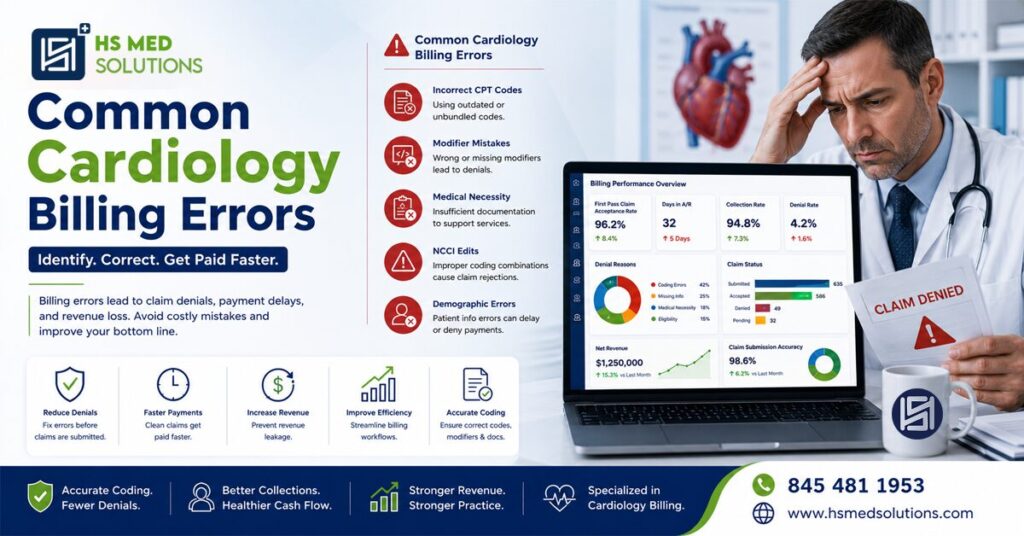
Common cardiology billing errors are costing U.S. cardiology practices millions of dollars every year in denied claims, delayed reimbursements, and compliance risks. According to the 2023 MGMA report, coding errors generated $68 billion in annual denied claim losses across U.S. healthcare providers. Cardiology practices lose 5–8% of collectible revenue due to billing mistakes and claim denials. These losses build up silently over time. Eventually, they can threaten the financial stability of the entire practice. Cardiology billing mistakes are not always the result of negligence. Often, they stem from the sheer complexity of cardiovascular coding. A single patient encounter can generate multiple high-value CPT codes, require payer-specific prior authorization, and demand meticulous documentation to satisfy medical necessity criteria. Therefore, even experienced billing teams make errors that trigger denials when they lack cardiology-specific training. This guide identifies the ten most common cardiology billing errors that practices across the United States face. Furthermore, it explains exactly why each error happens, what it costs your practice, and what your billing team should do to prevent it. Whether you manage billing in-house or partner with cardiology billing services, understanding these errors is the first step toward protecting your revenue. Practices that already follow a comprehensive cardiology medical billing guide can often reduce denial rates before they become a major revenue issue. Why Accurate Cardiology Billing Matters More Than Ever Cardiology practices operate under more billing scrutiny than almost any other specialty in the United States. Specifically, cardiology claim denial rates run between 15 and 20 percent, far above the 5 to 10 percent average across all specialties. Furthermore, MGMA data from 2025 confirms that operating costs for medical groups rose more than 11 percent, while reimbursement rates remained largely flat. In that financial environment, billing errors are not minor inefficiencies. They are direct threats to practice viability. Additionally, the administrative cost of correcting billing errors compounds the financial damage. Appealing a single denied claim costs a practice an average of 25 to 35 dollars in staff time. Multiply that across hundreds of monthly denials in a busy cardiology practice, and the operational burden becomes significant. Moreover, up to 50 percent of denied claims are never resubmitted at all, according to MGMA benchmarks. Consequently, every denied claim that goes unworked represents permanent revenue loss. The good news is that most common cardiology billing errors are preventable. Specifically, the 2023 MGMA report found that 42 percent of cardiology denials link directly to missing documentation or modifier errors, two problems that process improvement and coder training can address systematically. Therefore, identifying and eliminating these errors is not just a billing goal. It is a strategic financial priority for every cardiology practice. HS MED Solutions has helped cardiology practices across the United States reduce their denial rates from above 15 percent to below 5 percent through specialty-specific billing workflows, quarterly coding audits, and proactive denial management. Contact us at info@hsmedsolutions.com or 845-481-1953 to schedule a free billing analysis. Top Common Cardiology Billing Errors and How to Fix Them 1. Incorrect CPT Code Selection Incorrect CPT coding is the single most frequent cause of cardiology claim denials. Specifically, cardiology covers more than 200 procedure-specific CPT codes across echocardiography, stress testing, cardiac catheterization, electrophysiology, and interventional procedures. Selecting a code that does not precisely match the documented service, even by one digit, triggers an immediate denial or a payment at the wrong rate. Furthermore, 2026 brought major CPT restructuring in the PCI category. Six branch vessel add-on codes were permanently deleted, and two new codes (92930 and 92945) were introduced. Practices that have not updated their charge master for 2026 are submitting incorrect codes on every PCI claim they file this year. Consequently, outdated code sets are one of the fastest ways a high-volume cardiology practice loses revenue. ✔ Update your charge master, EHR code library, and coder reference sheets every January 1. Subscribe to AMA CPT update notifications and American College of Cardiology coding corner alerts to stay current throughout the year. Additionally, review our full cardiology CPT codes reference guide for 2026 code changes. 2. Missing or Insufficient Documentation Documentation gaps are the leading cause of post-payment audit failures in cardiology. Specifically, the 2023 MGMA report attributes 42 percent of all cardiology claim denials to missing documentation or modifier errors. A chart that looks complete to a clinician may still fall short of what a payer’s medical reviewer needs to approve reimbursement. For high-value cardiology procedures, documentation standards are strict. A complete transthoracic echocardiogram (CPT 93306) requires all standard cardiac views with chamber measurements. A nuclear stress test (CPT 78452) requires documentation of the injection protocol, stress type, tracer used, and all 17 myocardial segments. A cardiac catheterization report must include pre-procedure evaluation, contrast usage, and detailed procedural findings. Therefore, if any of these elements are missing, the claim is vulnerable, not just to denial but to post-payment recovery demands. ⚠ Do not code ahead of documentation. If a physician’s note does not support a complete study, bill the lower-level code that the documentation does support. Overcoding is a compliance risk, not just a billing error. 3. Upcoding and Downcoding Upcoding means billing a higher-level service than the documentation supports. Downcoding means billing below the documented level of service. Both are problems, though for different reasons. Upcoding creates fraud and abuse exposure and triggers payer audits. Downcoding, on the other hand, leaves legitimate reimbursement uncollected, a common issue in cardiology practices where billers are overly conservative to avoid audit risk. In echocardiography, the difference between a limited study (CPT 93308) and a complete study (CPT 93306) represents a significant reimbursement gap. Billing 93308 when the documentation supports 93306 is a real form of revenue loss. Conversely, billing 93306 when only a limited study was performed and documented is upcoding. Therefore, coders must evaluate every cardiology encounter against actual documentation, not against what the cardiologist typically performs or what reimburses at a higher rate. ✔ Implement a documentation checklist for high-value cardiology procedures. The checklist should specify exactly which