
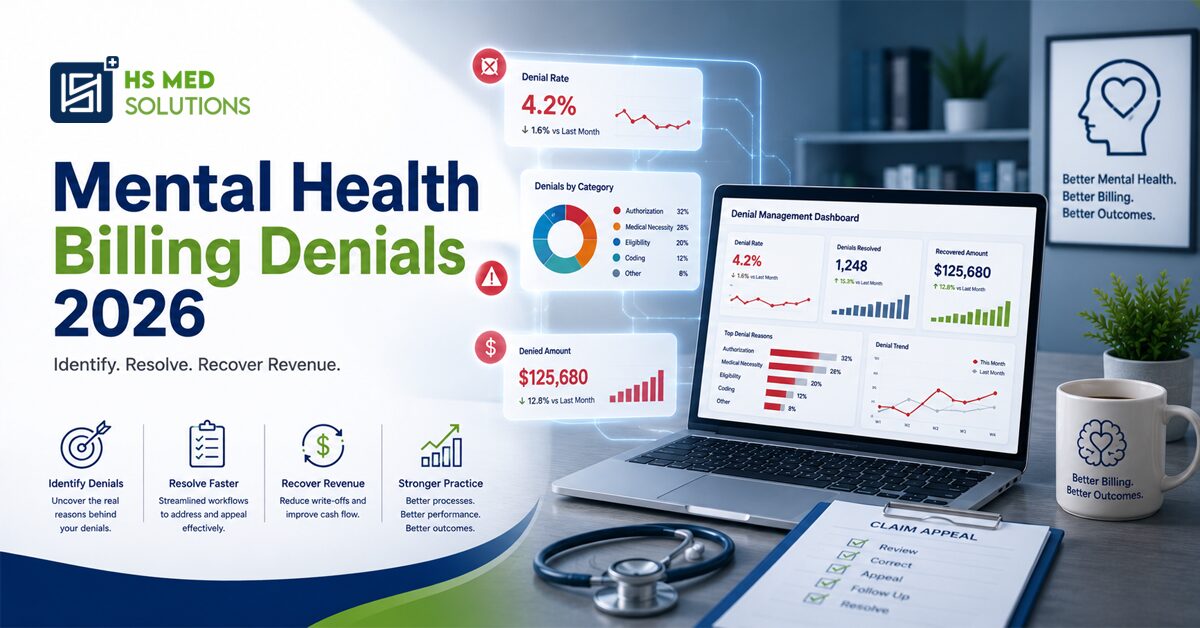
If you manage billing for a behavioral health practice, you already know the frustration. A claim goes out clean. Days later, an Explanation of Benefits comes back with a denial code instead of a payment. You investigate, find a fixable error, correct it, and resubmit. Then another denial comes in while you were working on the first one. And another.
Mental health billing denials are not just an administrative annoyance. They represent real money that your practice earned and has not yet collected. For a practice billing one million dollars annually, a denial rate of 20 percent puts two hundred thousand dollars at risk every single year. Some of that comes back through diligent follow-up. Much of it does not, because most behavioral health practices lack the systematic process to pursue every denied claim before deadlines pass.
This guide explains exactly why mental health billing denials happen, what the denial codes on your EOBs actually mean, how to appeal effectively, and what a real denial prevention system looks like in practice.
Denials vs Rejections: Get This Right First
Before anything else, understand the difference between a rejection and a denial. They look similar but require completely different responses, and confusing them wastes time.
A rejection happens before the claim reaches the payer for adjudication. The clearinghouse or the payer’s front-end system kicks it back because something is structurally wrong, like a missing field, an invalid NPI, or a formatting error. Rejections do not generate an EOB. They show up in your clearinghouse reports with a reason code. Fix the error and resubmit the same claim. Rejections do not consume your timely filing window.
A denial happens after the claim clears the front end and reaches adjudication. The payer reviewed it and decided, for some reason, not to pay it. Denials appear on an EOB with adjustment reason codes and remark codes. Denials do consume your timely filing window if you resubmit as a new claim rather than as a corrected claim. They also require a different response depending on the reason for the denial.
This distinction matters because the right response to a CO-197 denial (missing authorization) is completely different from the right response to a CO-50 denial (medical necessity). Treating every denial the same way is one of the most common and most expensive mistakes behavioral health billing teams make.
The Real Cost of Mental Health Billing Denials
Behavioral health claims are denied at rates 85 percent higher than comparable medical claims, according to American Psychological Association research. The industry average denial rate for mental health claims sits between 15 and 20 percent nationally. In practices with high telehealth volume or complex payer mixes, rates can climb to 25 percent or more.
Beyond the claim value itself, every denied claim costs approximately twenty-five dollars in additional staff labor to investigate, categorize, correct, and resubmit. Across a practice generating five hundred denials per month, that works out to more than twelve thousand dollars annually in rework cost, before accounting for the revenue those claims represent.
There is also a less visible cost: staff morale and focus. When billing teams spend their time chasing denials reactively, they have less capacity for clean claim submission, proactive authorization management, and the eligibility verification work that prevents denials in the first place. Denial management can become a cycle that feeds itself when it is not properly organized.
The good news is that appeals work. Research consistently shows that between 39 and 59 percent of appealed mental health billing denials result in payment when the appeal is properly documented and filed on time. The problem is that fewer than one percent of denied claims actually get appealed in most practices. That is not a reflection of the claims’ merit. It reflects a lack of process.
Mental Health Billing Denial Codes
What Your EOB Is Actually Telling You
The Explanation of Benefits your practice receives after adjudication contains Claim Adjustment Reason Codes (CARCs) and Remittance Advice Remark Codes (RARCs). Together, these codes tell you exactly why the payer denied or adjusted the claim. Most billing teams know a handful of common codes. Understanding the full set specific to behavioral health allows you to categorize denials accurately and respond strategically.
| Code | Who Sends It | What It Means in Plain English | Most Common Cause in Mental Health |
|---|---|---|---|
| CO-4 | Payer | Procedure code is inconsistent with the modifier or service billed | Wrong modifier for telehealth modality (95 applied to audio-only, or vice versa) |
| CO-11 | Payer | Diagnosis code is inconsistent with the procedure billed | Unspecified ICD-10 code used where a specific code is required by payer policy |
| CO-16 | Payer | Claim lacks information or has a submission or billing error | Missing NPI, missing authorization number, or incomplete claim fields |
| CO-22 | Payer | This care may be covered by another payer per coordination of benefits | Carve-out not identified; claim sent to wrong payer |
| CO-29 | Payer | The time limit for filing the claim has expired | Practice missed the timely filing window, often 90 days to 12 months |
| CO-45 | Payer | Charge exceeds the fee schedule or maximum allowable amount | Practice charged above contracted rate; typically adjusted automatically |
| CO-50 | Payer | These are non-covered services because this is not deemed medically necessary | Insufficient documentation of medical necessity in clinical notes |
| CO-96 | Payer | Non-covered charge(s) | Service not covered under the patient?s specific behavioral health benefit |
| CO-97 | Payer | Payment adjusted because the benefit for this service is included in another service | Psychotherapy add-on billed without a valid primary code on the same claim |
| CO-197 | Payer | Precertification/authorization/notification absent | Missing, expired, or incorrectly applied prior authorization number |
| PR-1 | Payer | Deductible amount applied | Not a denial; patient owes the deductible portion of the charge |
| PR-2 | Payer | Coinsurance amount applied | Not a denial; patient owes coinsurance |
| OA-23 | Payer | The impact of prior payer(s) adjudication including payments and/or adjustments | Secondary payer coordination issue; primary EOB not submitted correctly |
A few of these codes deserve specific attention in behavioral health. CO-50 and CO-197 are the two highest-revenue denial codes in most mental health practices. CO-50 means the payer is challenging medical necessity, which requires a clinical documentation response, not a billing correction. CO-197 means authorization was missing, expired, or invalid, which requires authorization verification and often a retro-authorization request before resubmission. Treating these two codes with the same workflow is a guaranteed way to lose both appeals.
Also note that PR-1 and PR-2 are not denials at all. They represent patient responsibility amounts, which should be posted to the patient ledger, not worked as denials. Many billing teams waste time attempting to “appeal” patient deductible and coinsurance amounts, which wastes resources on amounts that are not actually owed by the payer.
The Most Common Mental Health Billing Denial Reasons
Mental health billing denials cluster into several recognizable categories. Each category has its own causes and its own resolution path. Understanding which category a denial falls into is the first step toward recovering the revenue efficiently.
Eligibility and Coverage Denials
Eligibility denials happen when the payer determines that the patient’s coverage does not include the billed service, or that coverage was not active on the date of service. In behavioral health, these denials carry a complication that does not exist in most medical billing: the carve-out.
Many insurance plans separate mental health benefits from medical benefits and contract them to a different managed behavioral health organization. When a provider submits a psychotherapy claim to the primary medical insurer without knowing about the carve-out, the claim comes back denied with a CO-22 code indicating coordination of benefits issues. The fix requires identifying the correct mental health payer and resubmitting there, which often means starting the timely filing clock from scratch.
The prevention is straightforward but requires discipline: verify mental health benefits specifically, not just general insurance coverage, before every patient’s first appointment. Confirm whether a carve-out exists and which organization manages the behavioral health benefit. Document this information in the patient record and recheck it at least annually.
Prior Authorization Denials
Prior authorization denials, which typically arrive as CO-197, are the most expensive single denial category in behavioral health billing. They are also among the most preventable.
The challenge with authorization in mental health is that it is not a one-time event. Many payers require authorization before the first session, then again after a set number of sessions, then on an ongoing basis for continued treatment. Each authorization has an expiration date, an approved session count, and approved CPT codes. If any of those parameters change, or if the authorization expires without renewal, every subsequent claim is at risk.
Retroactive authorization requests are sometimes available after a denial, but they are never guaranteed. Some payers accept them routinely. Others categorically deny them. The safest approach is to track every authorization in a dedicated system, set renewal reminders at least two weeks before the expiration date, and confirm the authorization number on every claim before submission.
When a CO-197 denial arrives despite having an authorization number on file, investigate before resubmitting. Common issues include an authorization number that was entered incorrectly, an authorization approved for a different CPT code than the one billed, or an authorization that was approved for a specific number of sessions and has been exhausted.
Medical Necessity Denials
Medical necessity denials, coded as CO-50, are the most complex category because they require a clinical response rather than an administrative correction. The payer is not saying the claim has a billing error. The payer is saying they do not agree that the treatment was medically necessary.
In behavioral health, medical necessity is particularly vulnerable to challenge because it is partly subjective. Payers use clinical review criteria, often from InterQual or MCG, to evaluate whether the frequency, duration, and level of care billed is appropriate for the documented diagnosis. When clinical documentation does not use the language and specificity those criteria require, denials follow.
The appeal strategy for a CO-50 denial is to submit additional clinical documentation along with a written argument that specifically addresses the payer’s criteria. A form letter does not work here. The appeal needs to cite the patient’s diagnosis, functional impairment, treatment goals, and clinical justification for the frequency of sessions billed. When the denial involves complex clinical disagreements, requesting a peer-to-peer review with the payer’s medical director often produces better outcomes than a written appeal alone.
Coding Errors That Generate Denials
Coding-related denials are the most immediately correctable category. They arise from errors that can be fixed and resubmitted without a clinical review or authorization process. The risk is the timely filing deadline.
In behavioral health, the most common coding errors that cause denials include billing the wrong time-based psychotherapy code for the documented session length, applying modifier 95 to an audio-only telehealth session instead of modifier 93, billing CPT 90792 for a provider whose scope of practice does not include medical services, and submitting claims without the rendering provider’s individual NPI in addition to the group NPI.
CO-4 denials, where the procedure code is inconsistent with the modifier, are rising sharply as telehealth volume grows. Practices that added telehealth during the pandemic sometimes built those workflows quickly and never fully corrected the modifier and place-of-service combinations. Running a periodic audit of telehealth claim coding is one of the highest-return prevention activities a behavioral health billing team can do.
Timely Filing Denials
Timely filing denials are the most frustrating category because the underlying service was real, the documentation is complete, and the claim is otherwise clean, but the payer denies it anyway because too much time has passed since the date of service.
Most commercial payers set timely filing windows between 90 days and 12 months from the date of service. Medicare requires claims within one calendar year. Medicaid limits vary by state and can be as short as 60 days in some programs.
Once a timely filing denial arrives, recovery options are limited but not zero. If you have proof that the claim was submitted on time, either through a clearinghouse confirmation or a payer acknowledgment, you can appeal the denial with that documentation and often succeed. If the claim was genuinely not submitted within the window, the revenue is usually lost. This makes timely filing tracking one of the highest-priority prevention activities for any behavioral health billing operation.
Credentialing and Payer Enrollment Denials
Credentialing denials occur when the rendering provider is not yet enrolled with the payer, when their enrollment has lapsed, or when the claim identifies them incorrectly. These denials can be particularly damaging for new providers or for practices adding a new payer relationship, because they can hold up weeks of claims at once.
The most important thing to know about credentialing denials is that they are typically not retroactively correctable. Once a provider completes enrollment, future claims process normally, but claims submitted before the enrollment effective date remain denied in most cases. Planning credentialing timelines with a minimum 60 to 90 day runway before a new provider starts seeing insured patients is the only reliable prevention strategy.
Parity-Based Denials: When a Denial May Be Illegal
The Mental Health Parity and Addiction Equity Act (MHPAEA) requires insurance plans to cover mental health and substance use disorder services at the same level as comparable medical services. When a payer denies a mental health claim under criteria that would not be applied to a comparable medical claim, that denial may violate federal law.
Parity-based denials are most common in three situations: session limits that do not apply to comparable physical health treatment, prior authorization requirements that apply to mental health but not to analogous medical services, and medical necessity criteria that are more restrictive for behavioral health than for comparable medical diagnoses.
Appealing a parity violation is different from appealing a standard clinical denial. The appeal should explicitly cite MHPAEA, request a comparative analysis showing how the payer applies the disputed criteria to analogous medical services, and reference the applicable state parity law if the patient’s plan is state-regulated. Filing a complaint with your state insurance commissioner in parallel with the internal appeal often accelerates resolution. Federal regulators have been increasingly aggressive about MHPAEA enforcement, and payers know it.
How to Appeal a Mental Health Billing Denial
Effective appeal management follows a consistent sequence. Improvising a different approach for each denial produces inconsistent results and makes it impossible to identify patterns that reveal systemic problems.
- Read the denial carefully. Identify the CARC code, the RARC code if present, and the payer’s explanation. Do not assume you know why the claim was denied before reading the actual denial reason. CO-50 and CO-197 require completely different responses.
- Categorize the denial. Is it a billing error, a clinical dispute, an eligibility issue, an authorization issue, or a timely filing problem? The category determines the entire resolution path.
- Check the appeal deadline immediately. Do not file this step away for later. Different payer types have different windows. Commercial plans typically allow 90 to 180 days. Medicare allows 120 days. Missing the appeal deadline eliminates all recovery options.
- Gather the supporting documentation for your category. Coding errors need a corrected claim. Medical necessity denials need clinical documentation and a narrative argument. Authorization denials need proof of authorization or a retro-auth request. Eligibility denials need benefits verification from the correct payer.
- Write a clear appeal letter. State the patient name, date of service, claim number, and denial reason. Make your argument concisely and attach all supporting documentation. Reference the payer’s own clinical criteria when disputing a medical necessity denial.
- Submit the appeal through the correct channel. Some payers require online portal submission. Others accept fax. Confirm the submission method in the payer’s provider manual or by calling the provider services line.
- Document the submission. Keep a record of when and how you submitted the appeal, including confirmation numbers, fax transmission records, or portal receipts.
- Track the appeal through to resolution. Follow up at the midpoint of the expected decision window. Do not assume no news is good news.
Appeal Timelines by Payer Type
One of the most dangerous mistakes in denial management is treating all payers as if they share the same appeal rules. They do not. The table below shows appeal windows and expected decision timelines by payer category.
| Payer Type | Typical Appeal Window | First-Level Appeal Decision | External Review Available |
|---|---|---|---|
| Commercial Insurance | 90-180 days from denial date | 30-60 days after appeal submission | Yes, after internal appeals exhausted |
| Medicare | 120 days from denial date | 60 days for standard; 72 hours for expedited | Yes, through ALJ and Medicare Appeals Council |
| Medicaid | Varies by state; typically 60-90 days | 45-90 days after state-specific submission | Yes, state fair hearing process |
| ERISA Self-Funded Plans | 180 days from denial date | 60 days after voluntary appeal | Yes, federal external review rights apply |
ERISA self-funded plans deserve special mention. These are plans sponsored by employers under the Employee Retirement Income Security Act. State insurance regulations do not apply to ERISA plans, which sometimes surprises providers in states with strong parity laws. Federal ERISA regulations govern these plans, and they provide specific external review rights after internal appeals are exhausted. Parity claims against ERISA plans follow a federal regulatory framework rather than a state one.
When to Request a Peer-to-Peer Review
A peer-to-peer review is a direct conversation between the treating provider and the payer’s medical director or clinical reviewer. Most providers do not know this option exists, or they avoid it because it takes time away from patient care. It is, however, one of the most effective tools available for medical necessity denials on complex behavioral health cases.
Request a peer-to-peer when: the denial is based on medical necessity criteria and the clinical documentation strongly supports the treatment; the case involves a complex or treatment-resistant patient where standard criteria may not capture the full clinical picture; the denial is for inpatient psychiatric level of care; or the denial involves an unusual combination of services that a non-clinical reviewer may have misinterpreted.
The conversation typically lasts 15 to 30 minutes. The treating clinician presents the clinical rationale for the service directly to the payer’s reviewer. Success rates vary, but clinical staff who prepare thoroughly, know the payer’s specific criteria, and present the case in the clinical language those criteria use tend to convert a significant proportion of peer-to-peer reviews into approvals.
Request the peer-to-peer within the payer’s specified window, which is often 14 to 30 days from the denial date. Missing this window usually means the peer-to-peer option is no longer available for that claim.
Building a Denial Prevention System That Actually Works
Denial management is necessary, but denial prevention is more efficient. Every hour spent preventing a denial is worth more than several hours spent resolving one after the fact. A functional prevention system addresses the three stages where most behavioral health billing denials originate: before the patient is seen, at the time of coding, and at the point of submission.
Before the patient is seen, verify insurance eligibility specifically for mental health benefits, not general medical benefits. Confirm whether a carve-out applies and identify the correct behavioral health payer. Check prior authorization requirements and obtain authorization before the first appointment. Confirm that the treating provider is credentialed with this specific payer.
At the time of coding, confirm the documented session time before selecting a time-based psychotherapy code. Confirm the rendering provider’s scope of practice before billing CPT 90792. Confirm the patient’s location for any telehealth session and apply the correct POS code and modifier for that specific payer.
At the point of submission, run every claim through a claim scrubber that checks for common errors before transmission. Verify that the authorization number is present on every claim that requires one. Confirm that the rendering provider’s individual NPI appears on the claim, not just the group NPI.
Tracking denial patterns by code, payer, and provider over time is the most underused prevention tool. When CO-197 denials consistently come from one payer, that points to an authorization tracking problem with that payer’s specific workflow. When CO-4 denials cluster around one provider, that points to a telehealth coding education gap for that individual. Pattern data turns denial management from a reactive activity into a systematic improvement process.
When to Write Off vs When to Keep Fighting
Not every denied claim is worth the same level of effort to pursue. A thoughtful denial management program makes deliberate decisions about where to invest appeal time based on the value of the claim, the probability of success, and the time remaining before appeal deadlines.
Medical necessity denials with strong clinical documentation are worth pursuing aggressively, especially on high-value claims. The 39 to 59 percent appeal success rate cited earlier applies specifically to well-documented clinical appeals, not to appeals filed without additional evidence.
Timely filing denials are usually not worth appealing unless you have proof of timely submission that the payer missed. Without that proof, the revenue is typically unrecoverable.
Low-value claims under fifty dollars often cost more to appeal than the claim is worth in staff time. A deliberate write-off policy for claims below a certain value threshold, combined with a root-cause review to prevent similar claims from denying in the future, is more efficient than pursuing every denial regardless of value.
Parity-based denials are always worth pursuing, not only for the specific claim value but because successful parity appeals often force payers to change criteria that have been generating multiple similar denials across your patient population.
How HS MED Solutions Manages Mental Health Billing Denials
HS MED Solutions brings more than 25 years of revenue cycle management experience to behavioral health denial management. We do not manage denials reactively. We build systematic processes that prevent the most common denial categories before they occur, and respond strategically when denials do come in.
Our denial management approach includes:
- Categorizing every denial by code, payer, and root cause within 48 hours of receipt
- Maintaining a current appeal deadline tracker for every open denied claim
- Drafting category-specific appeal letters with supporting clinical documentation guidance
- Requesting peer-to-peer reviews on high-value medical necessity denials when clinically supported
- Monitoring authorization expiration dates and initiating renewal requests two weeks before expiration
- Running payer-specific claim scrubs before every submission to catch modifier, NPI, and coding errors
- Generating monthly denial trend reports that identify systemic issues by code, payer, and provider
- Tracking parity compliance and flagging potential MHPAEA violations for escalated appeal handling
Behavioral health practices that partner with HS MED Solutions typically see denial rates drop by 15 to 25 percent within the first 90 days as systemic coding and authorization errors are corrected. Collections improve further over the following six months as denied claims from prior periods are recovered through systematic appeals.
Whether you are dealing with a specific denial problem or looking for a billing partner who can manage your entire revenue cycle, we are ready to help. Contact HS MED Solutions at info@hsmedsolutions.com or 845-481-1953 to start a conversation about your practice’s denial situation.
Conclusion
Mental health billing denials are expensive, time-consuming, and largely preventable. The practices that recover the most revenue are not the ones that work the hardest on individual denials. They are the ones with the most consistent process: verifying benefits before every appointment, tracking authorizations proactively, coding accurately, submitting clean claims, and following up systematically on every denial before appeal windows close.
Understanding what your denial codes actually mean is the foundation of all of this. A CO-50 and a CO-197 look similar on a statement, but they require completely different responses. Building that literacy across your billing team, or partnering with a billing service that already has it, is the single most impactful step most behavioral health practices can take to improve collections.
HS MED Solutions specializes in behavioral health revenue cycle management, including denial prevention and recovery for mental health practices of all sizes. Reach out today to learn what a more systematic approach to denial management could mean for your practice revenue.
Frequently Asked Questions
Prior authorization issues are the most expensive single denial category in behavioral health billing. Missing authorization (CO-197), expired authorization, or authorization applied to the wrong CPT code together account for a large share of mental health billing denials. Eligibility and medical necessity denials are also among the most frequent.
A rejection occurs before adjudication and means the claim did not pass the payer's front-end validation. Fix the error and resubmit. A denial occurs after adjudication and means the payer reviewed the claim and decided not to pay it. Denials require category-specific responses and consume your timely filing window if not handled correctly.
Appeal windows vary by payer type. Commercial plans typically allow 90 to 180 days from the denial date. Medicare allows 120 days. Medicaid windows vary by state and can be as short as 60 days. ERISA self-funded plans allow 180 days. Always confirm the specific deadline with the payer's provider manual or provider services line.
CO-50 means the payer determined that the billed service was not medically necessary. This requires a clinical response, not a billing correction. You need to submit additional clinical documentation and a written argument that addresses the payer's specific medical necessity criteria. A form letter will not succeed on CO-50 appeals.
CO-197 means the claim was denied due to missing, expired, or invalid prior authorization. Investigate whether an authorization was obtained, whether it covers the billed CPT code, and whether it was still valid on the date of service. Depending on the payer, you may be able to request a retroactive authorization before resubmitting. If no authorization was ever obtained, contact the payer to ask whether a retro-auth is available for this denial.
A peer-to-peer review is a direct conversation between the treating clinician and the payer's medical director about a denied claim. It is most effective for medical necessity denials on complex behavioral health cases. Request it when your clinical documentation strongly supports the treatment, especially for inpatient psychiatric care or treatment-resistant cases. Most payers allow 14 to 30 days from the denial date to request a peer-to-peer.
Yes. The Mental Health Parity and Addiction Equity Act (MHPAEA) requires plans to cover mental health services at the same level as comparable medical services. If a payer applies session limits, prior authorization requirements, or medical necessity criteria to mental health claims that it does not apply to comparable medical claims, that denial may violate parity law. Cite MHPAEA in your appeal and request a comparative analysis from the payer.
A CO-22 denial code indicates a coordination of benefits issue, which often points to a carve-out. If the claim was submitted to the primary medical insurer but the patient's plan uses a separate behavioral health organization, the correct payer for mental health claims is that organization, not the primary medical plan. Always verify mental health benefits separately from general medical benefits.
Once the timely filing window closes, the denied revenue is typically unrecoverable unless you have documented proof that the claim was submitted on time. If you have clearinghouse confirmation or a payer acknowledgment showing timely submission, appeal with that documentation. Without proof, the claim is generally a write-off. This makes timely filing tracking one of the highest-priority activities in behavioral health billing.
Not always. Research shows 39 to 59 percent of appealed denials result in payment when well-documented, but the cost of the appeal process itself needs to factor into the decision. Medical necessity denials with strong clinical support are worth pursuing aggressively. Timely filing denials without proof of timely submission are usually not. Claims under fifty dollars often cost more to appeal than they are worth in staff time. Set a policy for your practice.
Verify mental health benefits specifically before every new patient appointment. Confirm carve-out arrangements and the correct behavioral health payer. Obtain prior authorization before the first session. Track authorization expiration dates and renew proactively. Run claims through a scrubber before submission to catch modifier, NPI, and coding errors. Track denial patterns monthly to identify and fix systemic issues.
A well-managed behavioral health billing operation should target a first-pass claim acceptance rate above 95 percent, meaning fewer than 5 percent of claims should deny on initial submission. The industry average in behavioral health is significantly worse, around 15 to 20 percent denial rates. Practices working with specialized behavioral health billing services consistently outperform that average.