
Mental Health Billing Denials | Causes, Codes & Appeals
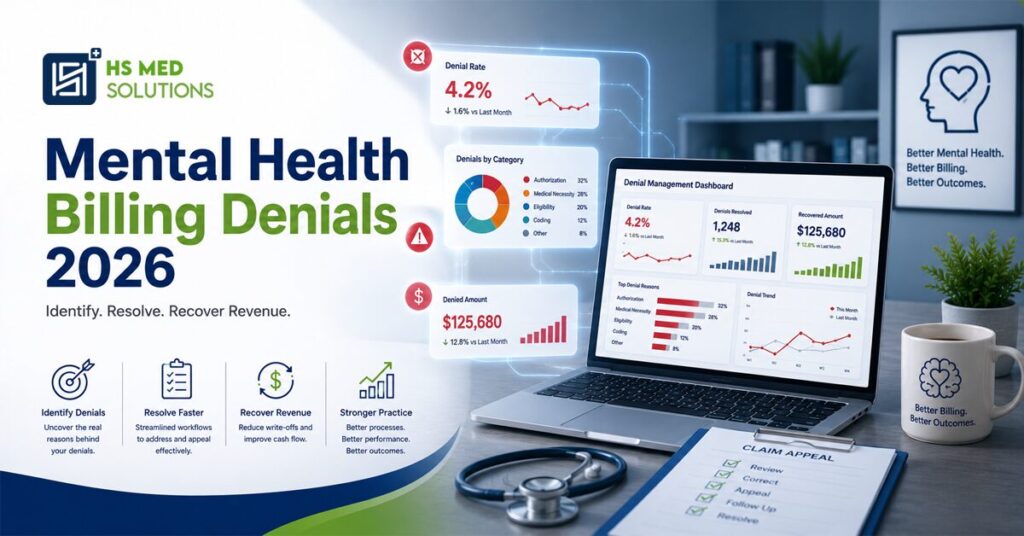
If you manage billing for a behavioral health practice, you already know the frustration. A claim goes out clean. Days later, an Explanation of Benefits comes back with a denial code instead of a payment. You investigate, find a fixable error, correct it, and resubmit. Then another denial comes in while you were working on the first one. And another. Mental health billing denials are not just an administrative annoyance. They represent real money that your practice earned and has not yet collected. For a practice billing one million dollars annually, a denial rate of 20 percent puts two hundred thousand dollars at risk every single year. Some of that comes back through diligent follow-up. Much of it does not, because most behavioral health practices lack the systematic process to pursue every denied claim before deadlines pass. This guide explains exactly why mental health billing denials happen, what the denial codes on your EOBs actually mean, how to appeal effectively, and what a real denial prevention system looks like in practice. Denials vs Rejections: Get This Right First Before anything else, understand the difference between a rejection and a denial. They look similar but require completely different responses, and confusing them wastes time. A rejection happens before the claim reaches the payer for adjudication. The clearinghouse or the payer’s front-end system kicks it back because something is structurally wrong, like a missing field, an invalid NPI, or a formatting error. Rejections do not generate an EOB. They show up in your clearinghouse reports with a reason code. Fix the error and resubmit the same claim. Rejections do not consume your timely filing window. A denial happens after the claim clears the front end and reaches adjudication. The payer reviewed it and decided, for some reason, not to pay it. Denials appear on an EOB with adjustment reason codes and remark codes. Denials do consume your timely filing window if you resubmit as a new claim rather than as a corrected claim. They also require a different response depending on the reason for the denial. This distinction matters because the right response to a CO-197 denial (missing authorization) is completely different from the right response to a CO-50 denial (medical necessity). Treating every denial the same way is one of the most common and most expensive mistakes behavioral health billing teams make. The Real Cost of Mental Health Billing Denials Behavioral health claims are denied at rates 85 percent higher than comparable medical claims, according to American Psychological Association research. The industry average denial rate for mental health claims sits between 15 and 20 percent nationally. In practices with high telehealth volume or complex payer mixes, rates can climb to 25 percent or more. Beyond the claim value itself, every denied claim costs approximately twenty-five dollars in additional staff labor to investigate, categorize, correct, and resubmit. Across a practice generating five hundred denials per month, that works out to more than twelve thousand dollars annually in rework cost, before accounting for the revenue those claims represent. There is also a less visible cost: staff morale and focus. When billing teams spend their time chasing denials reactively, they have less capacity for clean claim submission, proactive authorization management, and the eligibility verification work that prevents denials in the first place. Denial management can become a cycle that feeds itself when it is not properly organized. The good news is that appeals work. Research consistently shows that between 39 and 59 percent of appealed mental health billing denials result in payment when the appeal is properly documented and filed on time. The problem is that fewer than one percent of denied claims actually get appealed in most practices. That is not a reflection of the claims’ merit. It reflects a lack of process. Mental Health Billing Denial Codes What Your EOB Is Actually Telling You The Explanation of Benefits your practice receives after adjudication contains Claim Adjustment Reason Codes (CARCs) and Remittance Advice Remark Codes (RARCs). Together, these codes tell you exactly why the payer denied or adjusted the claim. Most billing teams know a handful of common codes. Understanding the full set specific to behavioral health allows you to categorize denials accurately and respond strategically. Export XLSExport CSV Code Who Sends It What It Means in Plain English Most Common Cause in Mental Health CO-4 Payer Procedure code is inconsistent with the modifier or service billed Wrong modifier for telehealth modality (95 applied to audio-only, or vice versa) CO-11 Payer Diagnosis code is inconsistent with the procedure billed Unspecified ICD-10 code used where a specific code is required by payer policy CO-16 Payer Claim lacks information or has a submission or billing error Missing NPI, missing authorization number, or incomplete claim fields CO-22 Payer This care may be covered by another payer per coordination of benefits Carve-out not identified; claim sent to wrong payer CO-29 Payer The time limit for filing the claim has expired Practice missed the timely filing window, often 90 days to 12 months CO-45 Payer Charge exceeds the fee schedule or maximum allowable amount Practice charged above contracted rate; typically adjusted automatically CO-50 Payer These are non-covered services because this is not deemed medically necessary Insufficient documentation of medical necessity in clinical notes CO-96 Payer Non-covered charge(s) Service not covered under the patient?s specific behavioral health benefit CO-97 Payer Payment adjusted because the benefit for this service is included in another service Psychotherapy add-on billed without a valid primary code on the same claim CO-197 Payer Precertification/authorization/notification absent Missing, expired, or incorrectly applied prior authorization number PR-1 Payer Deductible amount applied Not a denial; patient owes the deductible portion of the charge PR-2 Payer Coinsurance amount applied Not a denial; patient owes coinsurance OA-23 Payer The impact of prior payer(s) adjudication including payments and/or adjustments Secondary payer coordination issue; primary EOB not submitted correctly A few of these codes deserve specific attention in behavioral health. CO-50 and CO-197 are the two highest-revenue denial codes in most mental