
Medical Billing Trends for 2026
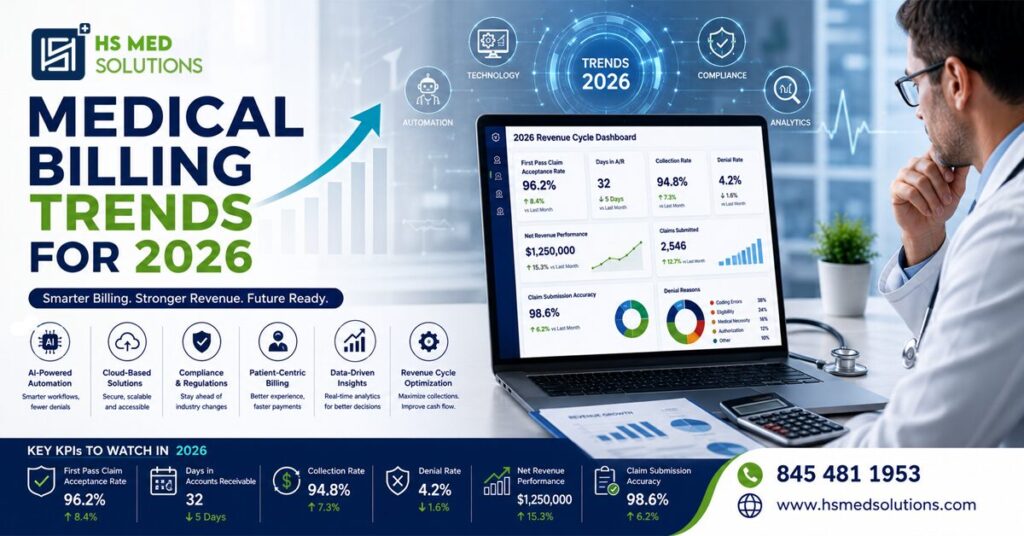
Medical billing trends for 2026 are reshaping how healthcare providers manage revenue, file claims, and get paid. Artificial intelligence now handles tasks that once required hours of manual review. Value-based care models are replacing simple fee-for-service billing in many specialties. Meanwhile, claim denial rates have climbed to nearly 12 percent industry wide, according to recent HFMA research. Practices that understand these medical billing trends can protect cash flow and avoid costly denials. This guide breaks down the ten biggest shifts in medical billing trends for 2026. It also covers the challenges they create and how your practice can prepare. Industry Overview Medical billing has moved far beyond simple paperwork. Today it functions as the financial engine of every healthcare practice. Revenue cycle management now touches scheduling, coding, claims submission, and patient collections. As a result, billing teams must master coding accuracy, payer policy, and compliance all at once. The global medical billing outsourcing market reflects this shift. It is projected to grow from 15.61 billion dollars to 40.43 billion dollars by 2033. That growth signals how seriously providers now treat their revenue cycle. Understanding medical billing trends for 2026 helps practices plan staffing, technology, and partnerships before problems appear. Why Medical Billing Is Changing in 2026 Several forces are driving medical billing trends for 2026. First, payers continue tightening prior authorization and documentation rules. Second, patients now carry a larger share of their own healthcare costs. Therefore, billing teams must communicate balances clearly and offer flexible payment options. Third, federal policy keeps shifting. CMS finalized its CY 2026 Physician Fee Schedule with separate conversion factors for alternative payment model participants and standard clinicians. This change alone affects how every practice calculates expected reimbursement. Meanwhile, staffing shortages push more practices toward automation and outsourced billing support. Together, these pressures explain why 2026 feels like a turning point rather than a routine update. Top Medical Billing Trends for 2026 The following ten medical billing trends for 2026 stand out as the most influential. Each one affects claim accuracy, cash flow, or patient experience in a measurable way. Artificial Intelligence in Medical Billing Artificial intelligence has moved past the pilot stage. In 2026, AI tools now flag coding errors before claims leave the building. They also predict which claims are likely to be denied. According to Guidehouse research, AI-powered coding support ranked as the top revenue cycle priority for medical groups this year. As a result, billing teams catch mistakes earlier and resubmit claims faster. However, AI still needs human oversight to interpret nuanced clinical documentation correctly. Predictive Analytics Predictive analytics gives billing teams a head start. Instead of reacting to denials, practices can now anticipate them. For example, software can flag a claim likely to fail eligibility checks before submission. Consequently, staff fix the issue early instead of waiting on a rejection. This shift saves time and protects monthly revenue projections. Automated Claims Processing Automated claims processing reduces the manual work behind every submission. Systems now auto-populate codes, verify modifiers, and check payer-specific rules in seconds. Furthermore, automation catches formatting errors that often cause instant rejections. Practices that adopt this technology typically see faster turnaround and fewer resubmissions. Still, automation works best when paired with experienced billing staff who can review edge cases. Revenue Cycle Automation Revenue cycle automation extends beyond claims into scheduling, eligibility, and collections. Tools now sync directly with electronic health records to reduce duplicate data entry. As a result, fewer claims get delayed due to mismatched patient information. Additionally, automated reminders help patients pay balances before accounts reach collections. This connected approach keeps the entire revenue cycle moving smoothly. Patient Payment Technology Patients now expect the same payment experience they get from retail apps. Mobile-friendly portals, text-to-pay links, and saved payment methods are becoming standard. Therefore, practices that modernize patient payment technology collect balances faster. In addition, transparent cost estimates before treatment reduce billing disputes later. This trend matters because patient responsibility now makes up a larger share of total revenue than it did five years ago. Real-Time Eligibility Verification Real-time eligibility verification confirms coverage before a patient even reaches the front desk. This prevents the common problem of treating a patient under the wrong plan. Moreover, real-time checks reduce claim denials tied to inactive coverage or missing authorization. Practices that verify eligibility at every visit, not just the first one, see noticeably cleaner claims. Value-Based Care Billing Value-based care billing ties payment to patient outcomes rather than visit volume. This model requires different documentation, coding, and reporting than fee-for-service billing. Consequently, practices entering value-based contracts need billing staff trained specifically for these arrangements. CMS continues expanding Alternative Payment Models and MIPS Value Pathways, which makes this trend harder to ignore in 2026. Data Security and Compliance Billing data security has become a board-level concern, not just an IT issue. Practices handle protected health information across more systems and vendors than ever before. As a result, HIPAA compliance now extends to every clearinghouse, portal, and automation tool in the billing chain. Strong access controls and regular audits help practices avoid costly breaches and penalties. Telehealth Billing Evolution Telehealth billing keeps evolving as coverage rules shift year to year. CMS extended waivers allowing rural health clinics and federally qualified health centers to bill for telehealth through 2026. Additionally, virtual presence now satisfies direct supervision requirements in many settings. Therefore, practices offering virtual care need billing staff who track these changes closely and apply the correct codes and modifiers. Outsourced Medical Billing Growth Outsourced medical billing continues its steady climb. Many practices simply lack the staff to track every payer update and coding change. Therefore, they turn to specialized billing partners who focus on this work full time. This trend connects directly to the challenges below, since outsourcing addresses many of them directly. Challenges Healthcare Providers Will Face These medical billing trends for 2026 bring real challenges alongside their benefits. Claim denial rates remain stubbornly high, with industry estimates near 12 percent. Meanwhile, staffing shortages make it harder to